
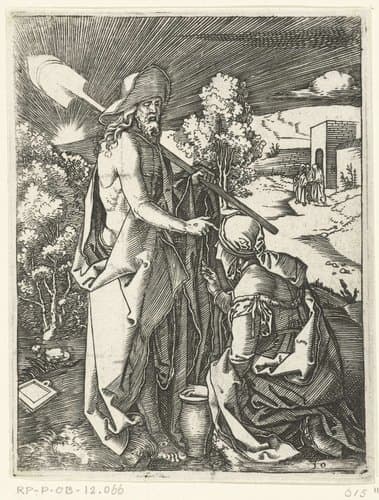
Christus verschijnt als tuinman met schop voor Maria Magdalena
1510 - 1515
Medium
engraving
Dimensions
100; 131
Rights
Public Domain
About this artwork
Prent naar houtsnede van Albrecht Dürer uit een serie van zevenendertig prenten met als onderwerp het levensverhaal van Christus, bekend als Passie van Christus.
Art Historical Context
In the Gospel of John, after His resurrection, Christ appears to Mary Magdalene disguised as a gardener, spade in hand—a poignant moment of mistaken identity and divine revelation. This intimate engraving, titled *Christus verschijnt als tuinman schop voor Maria Magdalena*, that scene with remarkable clarity. Created by Italian engraver Marcantonio Raimondi 1510–1515, it measures just 131 × 100 mm, yet brims with emotional depth and intricate detail. Raimondi faithfully reproduces acut from Albrecht Dürer's monumental series *The Passion of Christ*, comprising 37 prints chronicling Jesus's life and suffering. Dürer, a Northern Renaissance master, pioneered expressive woodcuts blending Gothic precision with emerging Renaissance humanism. Raimondi's engraving technique—using a burin to incise fine lines into copper plates—elevates the original, allowing subtler shading, textures like the gardener's spade and flowing robes, and a wider dissemination of Dürer's vision across Europe. This cross-cultural collaboration bridged Northern and Italian artistry during the High Renaissance. As a key reproductive print, it highlights engraving's role in democratizing art, making sacred narratives accessible beyond elite patrons. Visitors, imagine holding this tiny treasure: a testament to faith, technical innovation, and the enduring power of biblical storytelling.
About the Artist
Marcantonio Raimondi · 1475–1534
Marcantonio Raimondi (c. 1480–1534), born near Bologna, Italy, emerged as one of the Renaissance's premier engravers, revolutionizing printmaking through his mastery of reproductive techniques. He trained in the workshop of the goldsmith, painter, and niellist Francesco Francia, whose influence is evident in his early engravings, such as the goldsmith-like shading in *Pyramus and Thisbe* (1505), h...