
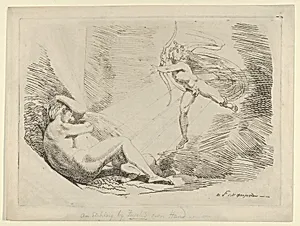
Chrysogone Conceives, in a Ray of Sunshine, Amoretta and Belphoebe (Edmund Spenser, "The Faerie Queene, III, vi)
1800–1810
Medium
Etching
Dimensions
Plate: 7 11/16 × 10 3/4 in. (19.5 × 27.3 cm) Sheet: 8 3/4 × 11 11/16 in. (22.2 × 29.7 cm)
Classification
Prints
Department
Drawings and Prints
Museum
Metropolitan Museum of Art, New York, NY
Credit
The Elisha Whittelsey Collection, The Elisha Whittelsey Fund, 1956
Accession Number
56.644.16
Rights
Public Domain
Tags
Art Historical Context
Henry Fuseli’s etching *Chrysogone Conceives, in a Ray of Sunshine, Amoretta and Belphoebe* captures a pivotal moment from Edmund Spenser’s epic poem *The Faerie Queene* (Book III, Canto vi). Created between 1800 and 1810, the work illustrates the miraculous conception of twin sisters Amoretta and Belphoebe, who are born when their sleeping mother, Chrysogone, is touched by sunbeams. Fuseli, a leading figure of Romanticism known for his dramatic literary illustrations, drew frequently from Spenser, Shakespeare, and Milton to explore themes of myth, desire, and the supernatural. Rendered as an etching—a medium prized in the early nineteenth century for its ability to convey intricate line work and tonal contrast—the print emphasizes the ethereal quality of the scene through delicate rays of light and expressive human figures. Fuseli’s dynamic composition heightens the poetic wonder of Spenser’s allegory, transforming a literary episode into a visually striking narrative. Housed in the Metropolitan Museum of Art’s collection of prints and drawings, this work reflects the period’s renewed interest in Renaissance literature and the Romantic fascination with imagination and the sublime. It invites viewers to consider how visual art can illuminate the symbolic richness of poetry.
About the Artist
Henry Fuseli · 1741–1825
Henry Fuseli (1741-1825), born Johann Heinrich Füssli in Zürich, was a Swiss-British painter whose visionary works exploring dreams, nightmares, and psychological terror made him one of the most original figures of the Romantic movement. His art bridged Neoclassical discipline with Romantic emotionalism, creating images of supernatural intensity that would influence artists from William Blake to t...