
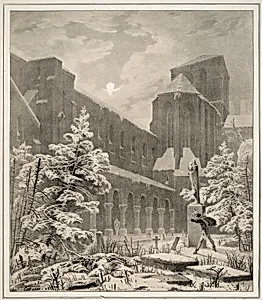
Church and Graveyard in the Snow by Moonlight
1827
Medium
Lithograph, with gray tone block on cream wove paper
Dimensions
Image: 41.4 × 35.9 cm (16 5/16 × 14 3/16 in.); Plate: 43.4 × 37.8 cm (17 1/8 × 14 15/16 in.); Sheet: 55.9 × 45 cm (22 1/16 × 17 3/4 in.)
Classification
lithograph
Department
Prints and Drawings
Museum
Art Institute of Chicago
Accession Number
148401
Rights
Public Domain
About this artwork
Blechen’s melancholy, monumental lithograph makes eloquent use of a gray tint block to evoke a snowy landscape and a sense of stillness. A lone man, cloak fluttering in the wind, has appeared surreptitiously at night to pay his respects to the dead. Perhaps in this moment he encounters his secret lover’s final resting place. Momentarily overcome with grief, he steadies himself on the plinth beneath a sculpture of the Madonna and Child.
Art Historical Context
Carl Blechen’s *Church and Graveyard in the Snow by Moonlight* captures a haunting winter night scene through the subtle tonal range of lithography. Created in 1827, the work depicts a solitary church and its graveyard blanketed in snow, illuminated only by the moon’s soft glow. The medium—a lithograph printed with an additional gray tone block on cream wove paper—allows Blechen to render delicate gradations of light and shadow, evoking the quiet stillness and chill of the landscape. As a leading figure in early German Romanticism, Blechen used such nocturnal subjects to explore themes of solitude, transience, and nature’s quiet power. The graveyard setting underscores the period’s fascination with mortality and the sublime, inviting viewers to reflect on human presence within a vast, indifferent world. Lithography, still a relatively new reproductive technique in the 1820s, enabled artists to share these atmospheric visions with a broader audience beyond traditional painting collectors. Measuring roughly 16 by 14 inches in the image area, the print balances intimacy with dramatic effect. Today housed in the Art Institute of Chicago’s Department of Prints and Drawings, it remains a compelling example of how Romantic artists harnessed emerging print technologies to convey mood and emotion.