
忠臣蔵三段目|Chushingura Act III
ca. 1800
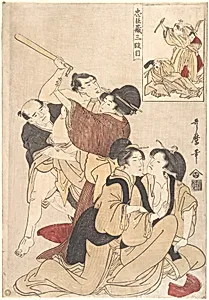
Medium
Woodblock print; ink and color on paper
Dimensions
H. 15 1/8 in. (38.4 cm); W. 10 1/2 in. (26.7 cm)
Classification
Prints
Culture & Period
Japan · Edo period (1615–1868)
Department
Asian Art
Museum
Metropolitan Museum of Art, New York, NY
Credit
Gift of Estate of Samuel Isham, 1914
Accession Number
JP996
Rights
Public Domain
Tags
Art Historical Context
Step into the vibrant world of Edo-period Japan Kitagawa Utamaro's *Chushingura Act III* (ca. 1800), a captivating woodblock print from the ukiyo-e tradition. scene captures a pivotal moment from the beloved kabuki play *Chura* (Treasury of the Loyal Retainers), which dramatizes the true story of the 47 ronin—samurai who avenged their lord's death through unwavering loyalty. Utamaro, renowned for his exquisite portraits of beautiful women (bijin-ga), here showcases his versatility in yakusha-e, or actor prints, blending dynamic poses of men and women on stage to evoke the theatre's dramatic energy. Printed with ink and color on paper in the standard oban format (15 1/8 x 10 1/2 in.), this work exemplifies ukiyo-e's technical brilliance: intricate woodblocks allowed for rich, layered colors and fine details, from flowing kimonos to expressive faces. During the Edo period (1615–1868), such affordable prints democratized kabuki culture, letting commoners relive theatrical spectacles at home. Utamaro's mastery of line and subtle gradations heightens the tension of Act III, where intrigue unfolds among retainers. Housed in the Metropolitan Museum of Art's Asian Art Department (gift of the Estate of Samuel Isham, 1914), this print not only celebrates Japan's theatrical heritage but also Utamaro's enduring influence on printmaking, bridging art and popular entertainment.
About the Artist
Kitagawa Utamaro · 1753–1806
Kitagawa Utamaro (c. 1753-1806) was one of the most celebrated masters of ukiyo-e woodblock printing, revolutionizing the art of bijin-ga (pictures of beautiful women) during Japan's Edo period. Born Kitagawa Ichitaro, his early life remains shrouded in mystery, with conflicting accounts placing his birth in Kyoto, Osaka, Yoshiwara in Edo (modern Tokyo), or Kawagoe in Musashi Province. Under the t...