
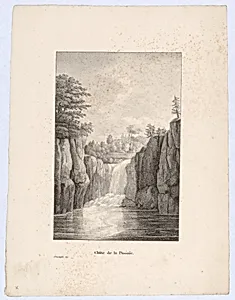
Chûte de la Passaïc
Medium
Lithograph
Dimensions
Image: 7 15/16 x 5 1/4 in. (20.2 x 13.4 cm) Sheet: 12 3/16 x 9 7/16 in. (30.9 x 23.9 cm)
Classification
Prints
Department
Drawings and Prints
Museum
Metropolitan Museum of Art, New York, NY
Credit
The Edward W. C. Arnold Collection of New York Prints, Maps and Pictures, Bequest of Edward W. C. Arnold, 1954
Accession Number
54.90.1204
Rights
Public Domain
Tags
Art Historical Context
This 1824 lithograph, titled *Chûte de la Passaïc*, captures the dramatic rush of Passaic Falls, a celebrated natural landmark in New Jersey. Created through the collaborative efforts of Charlotte and Michel-Ghislainleaux, the print reflects the early nineteenth-century fascination with America’s picturesque landscapes. As a lithograph, the work exemplifies the medium’s growing importance during this period, allowing artists to produce affordable, detailed images that could reach broader audiences beyond elite collectors. Charlotte Bonaparte, niece of Napoleon Bonaparte, brought a distinctive European perspective to her American subjects while Stapleaux contributed his expertise in printmaking. Their joint effort highlights the cross-cultural exchanges occurring in the 1820s, when European artists documented the young nation’s natural wonders. The modest scale of the image—roughly eight by five inches—makes the powerful cascade of water all the more striking, inviting viewers to appreciate both the force of nature and the technical precision of early lithography. Housed in the Metropolitan Museum of Art’s Department of Drawings and Prints, this work forms part of the Edward W. C. Arnold Collection. It offers today’s visitors a glimpse into how Romantic-era artists translated the sublime beauty of waterfalls into reproducible art, preserving these scenes for generations.