
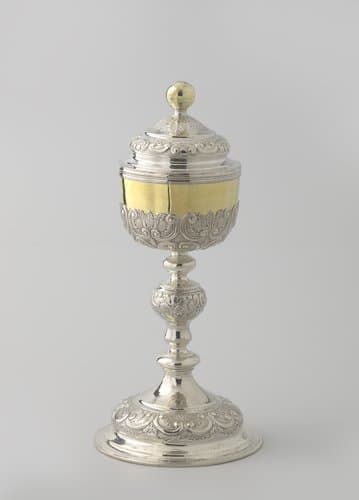
Ciborie van zilver met vergulde cuppa en dekselknop. Gewelfde voet en deksel; balusterstam. Versiering langs de randen met symmetrische rocailles op geponste grond.
Medium
gild
Dimensions
591; 30.3; 14.1
Rights
Public Domain
About this artwork
Ciborie van zilver met een vergulde cuppa en dekselknop. Om de gewelfde voet de balusterstam en het gewelfde deksel, randen met symmetrische rocailles tegen een geponste grond.
Art Historical Context
Step into the opulent world of 18th-century Dutch silversmithing with this exquisite *Ciborie van zilver met verguldepa en dekselknop* (Silver Ciborium with Gilded Bowl and Lid Knob), crafted master silversmith Petrus van Sanden in 1772. Standing at 303 cm tall with a 14.1 cm diameter and weighing a substantial 591 grams, this liturgical vessel was designed to hold the consecrated Eucharist in Catholic worship—a sacred object blending functionality with artistic splendor during the late Rococo era. The ciborium's elegant form features a curved foot, baluster stem, and matching domed lid, topped with a gilded knob for a harmonious silhouette. Its edges are adorned with symmetrical rocaille motifs—shell-like ornaments emblematic of Rococo exuberance—set against a finely punched ground texture, a technique that adds depth and shimmer through intricate hammering. The silver body contrasts beautifully with selective gilding on the bowl and knob, enhancing its glow under candlelight and symbolizing divine radiance. Produced in the Netherlands amid a revival of Catholic craftsmanship post-Reformation, Van der Sanden's work exemplifies the period's technical virtuosity and decorative refinement. Prized in church treasuries, such pieces not only served ritual purposes but also showcased the silversmith's skill, making this ciborium a luminous testament to 18th-century faith and artistry.