
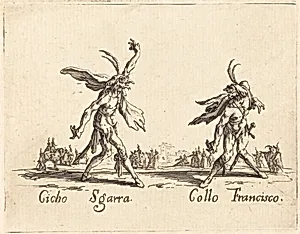
Cicho Sgarra and Collo Francisco
c. 1622
Medium
etching on laid paper
Dimensions
plate: 7 × 9.3 cm (2 3/4 × 3 11/16 in.) sheet: 10.1 × 12.4 cm (4 × 4 7/8 in.)
Classification
Department
CG-E
Museum
National Gallery of Art, Washington, D.C.
Credit
Rosenwald Collection
Accession Number
1946.21.207
Rights
Public Domain
Art Historical Context
Jacques Callot's *Cicho Sgarra and Collo Francisco* (c. 1622) a masterful small-scale etching on laid paper, measuring just 7 × 9.3 cm on the. Housed in the National Gallery of Art's Rosen Collection, this print exemplifies the Baroque artist's extraordinary skill in capturing intricate details within intimate formats. Callot, a French printmaker from Lorraine (1592–1635), honed his craft in Florence under the Medici patronage, revolutionizing etching techniques to produce finely wrought lines that rivaled engraving's precision. The title likely refers to two Italianate figures—possibly roguish characters or performers—rendered with Callot's signature economy and vitality. His innovative use of multiple acid bites on the copper plate allowed for rich tonal variations and delicate textures, making this work a gem of 17th-century printmaking. Etchings like this were affordable multiples, spreading sophisticated imagery to a wider audience beyond elite patrons. Part of the Prints department (CG-E), this piece highlights Callot's versatility, from theatrical scenes to war horrors, influencing later artists like Goya. Visitors will appreciate its technical brilliance up close, a window into early modern Europe's vibrant cultural life.
About the Artist
Jacques Callot · 1592–1635
Jacques Callot (1592–1635) was a French printmaker and draftsman from the Duchy of Lorraine, widely regarded as one of the first great artists to practice the graphic arts exclusively. His more than 1,400 etchings chronicled the breadth of 17th-century life, from Medici court festivities to the brutal realities of warfare. Callot revolutionized etching through technical innovations including the é...