
Circular box
Unknown Artist
ca. 1780
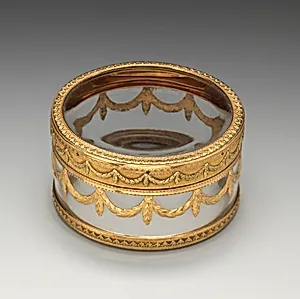
Medium
Two-tone gold, rock crystal
Dimensions
confirmed: 1 1/8 × 2 1/16 in. (2.9 × 5.3 cm)
Classification
Metalwork-Gold and Platinum
Culture
French
Department
European Sculpture and Decorative Arts
Museum
Metropolitan Museum of Art, New York, NY
Credit
Bequest of Mrs. Charles Wrightsman, 2019
Accession Number
2019.283.102
Rights
Public Domain
Art Historical Context
This exquisite circular box, crafted around 1780 in France by an unknown artist, exemplifies the pinnacle of18th-century European luxury metalwork. Measuring just 1 1/8 × 2 1/16 inches, its petite scale suggests it served as a snuffbox, bonbonnière, or patch—intimate accessories favored by the aristocracy. Fashioned from two-tone gold and translucent rock crystal, the piece showcases the era's masterful goldsmithing techniques, likely featuring engine-turned patterns in contrasting gold shades for a shimmering, reflective surface, topped with a crystal lid that catches the light like fine jewelry. Hailing from the opulent world of pre-Revolutionary France, this box reflects the cultural obsession with refined elegance during the late Rococo and early Neoclassical periods. French workshops, centered in Paris, were renowned for such objets de vertu, blending functionality with artistry to symbolize wealth and taste. Rock crystal, prized for its clarity and durability, elevated these items to collector's treasures, often customized for elite patrons. Now part of the Metropolitan Museum of Art's European Sculpture and Decorative Arts collection through the generous bequest of Mrs. Charles Wrightsman in 2019, this gem invites us to marvel at the anonymous craftsmanship that defined an age of splendor. Hold it close, and you'll sense the whispers of Versailles.