
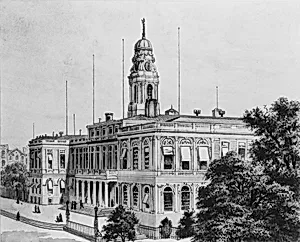
City Hall, New York
Unknown Artist
Medium
Watercolor and graphite on white wove paper
Dimensions
12 3/4 x 15 7/8 in. (32.4 x 40.3 cm)
Classification
Watercolor
Culture
American
Department
The American Wing
Museum
Metropolitan Museum of Art, New York, NY
Credit
The Edward W. C. Arnold Collection of New York Prints, Maps, and Pictures, Bequest of Edward W. C. Arnold, 1954
Accession Number
54.90.5
Rights
Public Domain
Tags
About this artwork
This early 19th-century watercolor and graphite work captures New York City Hall, one of the most significant architectural landmarks in American history. Completed in 1812 to designs by John McComb Jr. and Joseph François Mangin, City Hall stands as a masterpiece of Federal architecture, symbolizing the young nation's political aspirations and New York's emergence as a major urban center. This artwork dates from 1800-1850, a period of dramatic transformation when New York evolved from a post-co...
Art Historical Context
This delicate watercolor and graphite drawing on white wove paper captures York City Hall, a of American architecture completed in 1812 to designs by John McComb. and Joseph François Mang. Exemplifying Federal style, the building symbolized the young nation's democratic ideals and New York's rise from post-colonial port to bustling commercial hub during the transformative years of 1800–1850. At just 12¾ × 15⅞ inches, this anonymous work offers an intimate, precise view of the landmark before photography dominated urban documentation. Created in an era when watercolors served topographical purposes—often for engraving reproduction—the piece blends architectural accuracy with subtle atmospheric effects. Artists like English émigré William James Bennett produced similar scenes, recording the rapid evolution of American cities. The medium's fluid tonal gradations and graphite details highlight the building's elegant facade, turning a documentary record into an evocative aesthetic gem. Housed in The Metropolitan Museum of Art's American Wing as part of The Edward W. C. Arnold Collection, this artwork preserves a vivid snapshot of early 19th-century New York, evoking civic pride in a growing democracy. It reminds us how such images bridged art and history, immortalizing a city on the cusp of modernity.