
Clara Pilvois
1850s–60s
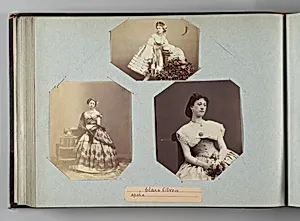
Medium
Albumen silver print from glass negative
Dimensions
Image: 5 3/8 × 4 5/8 in. (13.6 × 11.8 cm) Sheet: 10 3/8 × 13 3/4 in. (26.3 × 35 cm)
Classification
Photographs
Department
Photographs
Museum
Metropolitan Museum of Art, New York, NY
Credit
Gilman Collection, Gift of The Howard Gilman Foundation, 2005
Accession Number
2005.100.588.1.41
Rights
Public Domain
Art Historical Context
**Clara Pilvois**, a captivating portrait by pioneering French photographer André-Adol-Eugène Disdéri from the 1850s–60s, exemplifies the dawn of accessible photography. Captured as an albumen silver print from a negative, this intimate image measures 5 3/8 × 4 5/8 inches and is mounted on a larger sheet, suited to Disdéri's revolutionary *carte de visite*. These pocket-sized photographs became a sensation across Europe and America, allowing everyday people to collect and exchange portraits like trading cards. Disdéri's innovation transformed photography from an elite novelty into a mass medium, producing millions of these affordable prints during the Second Empire. The albumen process, using egg whites to bind light-sensitive silver salts, yielded rich tones and sharp detail, ideal for capturing the subject's poised elegance. Likely depicting a young woman—perhaps an actress or society figure—*Clara Pilvois* reflects the era's fascination with personal identity and celebrity in an age of rapid social change. Housed in The Metropolitan Museum of Art's Gilman Collection, this work highlights photography's cultural shift, bridging art and commerce while preserving fleeting moments of 19th-century life for us today.
About the Artist
André-Adolphe-Eugène Disdéri · 1819–1889
**André-Adolphe-Eugène Disdéri** (1819–1889) was a pioneering French photographer whose innovations transformed portraiture into a mass medium during the Second Empire. Born on March 28, 1819, in Paris, Disdéri pursued diverse careers in commerce, acting, and politics early on, while studying art amid personal hardships following his father's death, which compelled him to support his mother, sibli...