
Close-Helmet
Unknown Artist
ca. 1515, and later
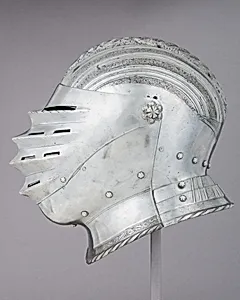
Medium
Steel, leather, gold
Dimensions
Bowl (a); H. 8 3/4 in. (22.2 cm); W. 7 7/8 in. (20 cm); D. 9 3/8 in. (23.8 cm); Wt. 3 lb. 11.4 oz. (1684 g); visor with bevor (b, c); H. 9 1/4 in. (23.5 cm); W. 8 3/4 in. (22.2 cm); D. 7 1/4 in. (18.4 cm); Wt. 2 lb. 4.6 oz. (1037.6 g); nape plates (d); H. 1 7/8 in. (4.8 cm); W. 8 1/2 in. (21.6 cm); D. 4 7/8 in. (12.4 cm); Wt. 4.8 oz. (136.1 g)
Classification
Helmets
Culture
Italian, Milan or Brescia
Department
Arms and Armor
Museum
Metropolitan Museum of Art, New York, NY
Credit
Gift of William H. Riggs, 1913
Accession Number
14.25.560a–d
Rights
Public Domain
Art Historical Context
Step into the world of Renaissance warfare with this exquisite *Close-Helmet*, crafted 1515 and later modified in northern Italy—likely Milan or Brescia, Europe's premier armor-making hubs. Dating to the early 16th century, helmet exemplifies the height of plate armor technology during the Italian Wars, when master armorer's guilds produced gear for elite men-at-arms and infantry. Its modular design—featuring a skull-like bowl, pivoting visor with protective bevor (chin guard), and sliding nape plates—allowed for secure enclosure of the head while permitting ventilation and vision through narrow eye slits. Forged from high-quality steel, reinforced with leather linings for comfort, and accented with gold for status, the helmet's robust construction (totaling over 6 pounds) balanced mobility with battlefield invulnerability. Milanese and Brescian workshops were renowned for their precise hammering, riveting, and polishing techniques, turning functional defense into sculptural art. Weighing in at precise measurements—like the bowl's 8¾-inch height—this piece highlights the era's engineering prowess. A generous gift from William H. Riggs in 1913, it now graces the Metropolitan Museum of Art's Arms and Armor Department, inviting you to ponder the human ingenuity behind the clash of swords.