
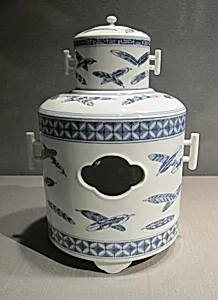
丁子風炉 平戸焼|Clove Boiler with Feathers
Unknown Artist
early 19th century
Medium
Porcelain with underglaze blue (Hirado ware)
Dimensions
H. 10 1/2 in. (26.7 cm); Diam. 6 3/4 in. (17.1 cm)
Classification
Ceramics
Culture & Period
Japan · Edo period (1615–1868)
Department
Asian Art
Museum
Metropolitan Museum of Art, New York, NY
Credit
Gift of Charles Stewart Smith, 1893
Accession Number
93.3.2a–c
Rights
Public Domain
Art Historical Context
This exquisite *Clove Boiler with Fe* (丁子風炉 平戸焼) is a fine example of Hirado ware a prized Japanese porcelain from the early th century during the Edo period (161–1868). Standing 10½ inches tall and 6¾ inches in diameter this portable brazier—known as a *furo*—was designed for the Japanese tea ceremony (*chanoyu*), where it gently heated water for matcha preparation. Its bulbous, clove-like form evokes natural elegance, while feather motifs in underglaze blue add a delicate, whimsical touch, reflecting the refined aesthetic of everyday rituals in urban Edo society. Hirado ware, produced on Hirado Island in Nagasaki Prefecture, emerged in the late 18th century as Japan's answer to imported Chinese porcelain. Artisans perfected the technique of underglaze blue—applying cobalt pigment directly onto the unfired porcelain body before glazing and high-temperature firing—which yielded vibrant, durable designs resistant to wear. This innovation made Hirado pieces highly sought after for tea utensils, blending functionality with subtle artistry and symbolizing the Edo era's cultural emphasis on *wabi-sabi* harmony. Generously gifted to the Metropolitan Museum of Art in 1893 by Charles Stewart Smith, this anonymous masterpiece invites visitors to appreciate the meticulous craftsmanship that bridged utility and beauty in Japanese ceramics. A testament to Edo ingenuity, it whispers of serene tea gatherings amid Japan's vibrant merchant culture.