
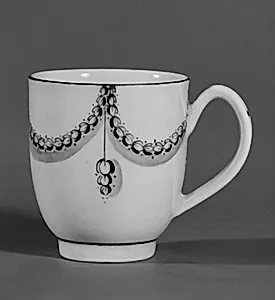
Coffee cup (part of a service)
ca. 1780–90
Medium
Soft-paste porcelain
Dimensions
Height (each): 1 13/16 in. (4.6 cm)
Classification
Ceramics-Porcelain
Culture
British, Caughley
Department
European Sculpture and Decorative Arts
Museum
Metropolitan Museum of Art, New York, NY
Credit
Gift of Dr. and Mrs. A. L. Garbat, 1961
Accession Number
61.107.372
Rights
Public Domain
Art Historical Context
This delicate coffee cup, produced by the Caughley Factory in Shropshire,, around 1780–90, exemplifies the refined porcelain craftsmanship of late 18th-century Britain. Part of a larger service, its petite height of just 1 13/16 inches (4.6 cm) made it perfectly suited for intimate social rituals like after-dinner coffee, a fashionable pastime among the growing middle and upper classes. Crafted from soft-paste porcelain—a European innovation blending white clay with ground glass and fired at lower temperatures than true Chinese hard-paste—this piece reflects Caughley's mastery in imitating Oriental imports. The factory, active from the 1770s to 1814, gained renown for affordable, high-quality wares often featuring blue underglaze designs inspired by East Asian motifs, fueling Britain's "porcelain mania" amid expanding global trade. Today, housed in the Metropolitan Museum of Art's European Sculpture and Decorative Arts Department (gift of Dr. and Mrs. A. L. Garbat, 1961), it highlights how industrial innovation democratized luxury, bridging everyday life with artistic elegance in Georgian England.