
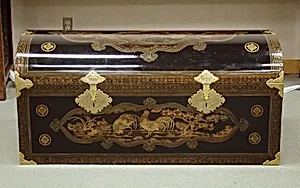
Coffer in Nanban (Southern Barbarian) Style
Unknown Artist
18th century
Medium
Black lacquer on wood with gold painted design
Dimensions
H. 24 13/16 in. (63 cm); W. 52 3/16 in. (132.6 cm); D. 23 7/16 in. (59.5 cm)
Classification
Furniture
Culture & Period
Japan · Edo period (1615–1868)
Department
Asian Art
Museum
Metropolitan Museum of Art, New York, NY
Credit
Gift of Mr. and Mrs. Norton W. Mailman, 1991
Accession Number
1991.408
Rights
Public Domain
Tags
Art Historical Context
Step into the opulent world of Edo-period Japan with this magnificent *Coffer in Nanban (Southern Barb) Style*, crafted by an unknown artist in the18th century. Measuring an impressive 24⅞ × 52¼ × 23½ inches, this wooden chest is adorned in lustrous black lacquer with intricate gold-painted designs featuring roosters and trees As a piece of furniture from the Metropolitan Museum of Art's Asian Art collection—generously gifted by Mr. and Mrs. W. Mailman in 1991—it exemplifies the grandeur of storage coffers used for valuables like clothing or treasures. The Nanban style draws from Japan's early encounters with European traders, particularly the Portuguese in the 16th century, whom the Japanese termed "Southern Barbarians." Though Japan entered a period of isolation (sakoku) during the Edo era (1615–1868), this aesthetic persisted, blending exotic Western motifs with native craftsmanship. Roosters, symbols of vigilance and good fortune, strut amid stylized trees, evoking nature's vitality against the lacquer's deep, mirror-like sheen. Japanese lacquerwork, or urushi-e, is a masterful technique involving layers of sap from the lacquer tree, polished to perfection and enhanced with gold makie (sprinkled gold powder). This coffer not only served practical purposes but also showcased artistic virtuosity, reflecting Japan's ability to absorb and transform foreign influences into enduring cultural treasures. A true fusion of East and West!