
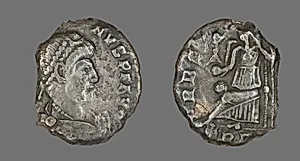
Coin Portraying an Emperor
late 4th century
Medium
Silver
Dimensions
Diam.: 1.5 cm (5/8 in.)
Classification
coin
Department
Arts of Greece, Rome, and Byzantium
Museum
Art Institute of Chicago
Accession Number
142675
Rights
Public Domain
About this artwork
The front (obverse) of this coin portrays a draped and diademed bust, possibly an emperor, facing right. On the back (reverse), the goddess Roma sits enthroned and crowned by Victory, which she holds.
Art Historical Context
This exquisite silver coin, struck in the late 4th during the waning years of the Roman Empire, exemplifies the artistry and propaganda power of ancient numismatics. Measuring just 1.5 cm in diameter, it features a portrait of an emperor—likely in profile, adorned with a laurel wreath or imperial regalia—on the obverse, a common design to immortalize rulers and assert their divine authority. Housed in the Art Institute of Chicago's Department of Arts of Greece, Rome, and Byzantium, this tiny artifact reveals the sophistication of Roman minting techniques, where hammered dies created finely detailed reliefs on precious metal. Roman coins like this siliqua (a standard late silver denomination) served as more than currency; they were imperial billboards, circulating across a vast empire from Britain to Egypt. In the turbulent late 4th century, amid barbarian invasions and the empire's division into East and West, such portraits reinforced the emperor's image as a stabilizing force—perhaps evoking figures like Theodosius I, who championed Christianity. The silver medium, though debased over time, underscored Rome's economic might and the value placed on imperial likenesses. Artistically, these coins blend realism with idealism, capturing facial features with remarkable precision for such a small scale. They bridge sculpture and everyday life, offering modern viewers a direct glimpse into Roman identity, power, and the dawn of the Byzantine era. A testament to endurance, this coin outlasted empires.
About the Artist
Ancient Roman
The artists attributed to "Ancient Roman" in museum collections represent the anonymous craftsmen who produced the vast output of sculpture, frescoes, mosaics, and reliefs defining Roman visual culture from the Republic (c. 509–27 BCE) to the late Empire (c. 395 CE). Individual identities remain elusive, as Roman makers were typically viewed as skilled tradesmen—often enslaved Greeks or provincial...