
Coin Portraying Emperor Constantine I
310-311
Medium
Bronze
Dimensions
Diam.: 1.9 cm (3/4 in.)
Classification
coin
Department
Arts of Greece, Rome, and Byzantium
Museum
Art Institute of Chicago
Accession Number
142631
Rights
Public Domain
About this artwork
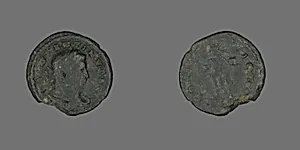
The front (obverse) of this coin portrays the emperor Constantine I, facing right and wearing a crown of laurels. On the back (reverse), the sun deity Sol is depicted standing, wearing a radiate crown and holding a globe in his left hand while rasing his right.
Art Historical Context
This petite bronze coin, struck around 310-311 CE during the early reign of Emperor Constantine I, captures the formidable profile of one of Rome's most transformative leaders. Measuring just 1.9 cm in diameter, it exemplifies the Ancient Roman art of numismatics—coins as miniature masterpieces of propaganda and portraiture. Displayed in the Art Institute of Chicago's Department of Arts of Greece, Rome, Byzantium, it offers a tangible glimpse into the late Roman Empire's visual culture. Constantine I (r. 306-337 CE) rose amid civil wars, eventually unifying the empire and paving the way for Christianity's official adoption via the Edict of Milan in 313. Coins like this were essential tools for emperors, circulating his image across provinces to assert authority, inspire loyalty, and standardize currency. The bronze medium, durable yet affordable, allowed mass production, making imperial iconography accessible to soldiers, merchants, and citizens alike. Artistically, Roman coins blended realism with idealism: the emperor's features—strong jaw, laurel wreath—convey power and divinity, a technique honed over centuries from Greek influences. This unassuming artifact underscores how everyday objects shaped history, bridging art, politics, and economy in antiquity.
About the Artist
Ancient Roman
The artists attributed to "Ancient Roman" in museum collections represent the anonymous craftsmen who produced the vast output of sculpture, frescoes, mosaics, and reliefs defining Roman visual culture from the Republic (c. 509–27 BCE) to the late Empire (c. 395 CE). Individual identities remain elusive, as Roman makers were typically viewed as skilled tradesmen—often enslaved Greeks or provincial...