
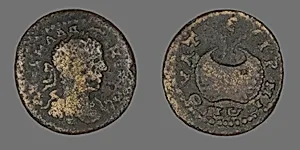
Coin Portraying Emperor Elagabalus
218-222
Medium
Bronze
Dimensions
Diam.: 2.7 cm (1 1/8 in.)
Classification
coin
Department
Arts of Greece, Rome, and Byzantium
Museum
Art Institute of Chicago
Accession Number
142954
Rights
Public Domain
About this artwork
The front (obverse) of this coin portrays the emperor Elagabalus. The back (reverse) shows two palms in a prize urn.
Art Historical Context
This bronze coin, struck during the brief tumultuous reign of Emperor Elabalus (r. 218–222 CE), offers a glimpse into the propaganda of Rome. Measuring just 2.7 cm in diameter, it features a portrait of the young emperor, whose real name was Varius Avitus Bassianus Elagabalus, a Syrian priest elevated to the throne by the Roman legions, is depicted in the classic style of imperial coinage—idealized profile, laurel wreath, and authoritative gaze—to legitimize his rule across the vast empire. Roman coins like this were not mere money but powerful tools of communication, circulated from Britain to Egypt. Minted in bronze for everyday use, they bore the emperor's image on one side and symbolic motifs like deities or victories on the other, reinforcing imperial divinity and stability. Elagabalus' coins reflect his controversial push to elevate the sun god Elagabal over traditional Roman gods, sparking outrage that led to his assassination at age 18. As a numismatic artifact in the Art Institute of Chicago's Arts of Greece, Rome, and Byzantium collection, this piece highlights the artistry of Roman die-engraving—precise, high-relief portraits achieved through hammered metalwork. It invites us to ponder how even pocket change shaped history and public perception in antiquity.
About the Artist
Ancient Roman
The artists attributed to "Ancient Roman" in museum collections represent the anonymous craftsmen who produced the vast output of sculpture, frescoes, mosaics, and reliefs defining Roman visual culture from the Republic (c. 509–27 BCE) to the late Empire (c. 395 CE). Individual identities remain elusive, as Roman makers were typically viewed as skilled tradesmen—often enslaved Greeks or provincial...