
Coin Portraying Emperor Hadrian
133-134
Medium
Bronze
Dimensions
Diam.: 3.3 cm (1 5/16 in.)
Classification
coin
Department
Arts of Greece, Rome, and Byzantium
Museum
Art Institute of Chicago
Accession Number
139870
Rights
Public Domain
About this artwork
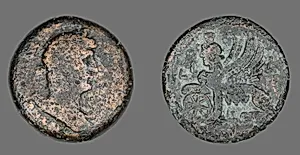
The front (obverse) of this coin portrays the head of Emperor Hadrian, facing right, filleted. The back (obverse) depicts a Sphinx, seated, facing left, with wings open and a modius (headdress).
Art Historical Context
This bronze coin, struck in 133-134 CE during the later years of Emperor Hadrian's reign (117-138 CE), offers a glimpse into the power propaganda of ancient Rome. Hadrian, known for his extensive travels and architectural legacy like the Pantheon and Hadrian's Wall, depicted in profile on the obverse—a common Roman convention symbolizing imperial authority and divine favor. At just 3.3 cm in diameter, everyday currency from the Art Institute of Chicago Arts of Greece, Rome, and Byzantium collection circulated widely, blending artistry with economics. Crafted through die-striiking, where engraved metal dies hammered the design into a bronze flan, the coin showcases Roman mastery of portraiture. Hadrian's realistic features—curly hair, full beard, and laurel wreath—reflect the classical idealism of imperial coinage, evolving from Greek influences toward individualized likenesses. Bronze sestertii like this were valued for their durability and detail, making them accessible canvases for state messaging on the reverse, often featuring victories, deities, or provincial symbols. As both money and miniature sculpture, such coins democratized imperial imagery, reinforcing loyalty across the vast empire. Handling one today connects us to the daily life of Romans, where even pocket change carried the weight of history.
About the Artist
Ancient Roman
The artists attributed to "Ancient Roman" in museum collections represent the anonymous craftsmen who produced the vast output of sculpture, frescoes, mosaics, and reliefs defining Roman visual culture from the Republic (c. 509–27 BCE) to the late Empire (c. 395 CE). Individual identities remain elusive, as Roman makers were typically viewed as skilled tradesmen—often enslaved Greeks or provincial...