
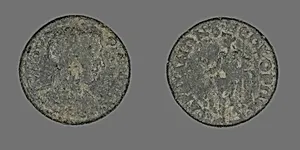
Coin Portraying King Philip II
244-249
Medium
Bronze
Dimensions
Diam.: 2.3 cm (15/16 in.)
Classification
coin
Department
Arts of Greece, Rome, and Byzantium
Museum
Art Institute of Chicago
Accession Number
142915
Rights
Public Domain
Art Historical Context
This bronze coin, struck during the turbulent mid-3rd century AD (244–249), portrays the young Roman emperor Philip II, son of Philip the Arab. Minted by Ancient Roman artisans, its modest diameter of 2.3 cm belies its role as a powerful tool of imperial propaganda. Displayed in the Art Institute of Chicago Department of Arts of Greece, Rome, Byzantium, it exemplifies the everyday artistry of the late Roman Empire, circulating wealth, authority, and the emperor's visage across the vast realm. Roman coins like this one were more than currency; they were miniature billboards of power. During the Crisis of the Third Century—a time of invasions, civil wars, and economic strain—emperors like Philip II used such portraits to assert legitimacy and divine favor. The obverse likely features the youthful ruler's idealized profile, laurel-wreathed to evoke classical heroism, while the reverse might depict victories or deities, reinforcing cultural and religious ties. Crafted via die-stamping on bronze, a durable yet accessible medium, the coin showcases fine engraving techniques that captured subtle facial details and inscriptions in Latin. These small masterpieces highlight Rome's blend of Greek-influenced realism and imperial symbolism, offering visitors a tangible glimpse into an empire's fragile grandeur.
About the Artist
Ancient Roman
The artists attributed to "Ancient Roman" in museum collections represent the anonymous craftsmen who produced the vast output of sculpture, frescoes, mosaics, and reliefs defining Roman visual culture from the Republic (c. 509–27 BCE) to the late Empire (c. 395 CE). Individual identities remain elusive, as Roman makers were typically viewed as skilled tradesmen—often enslaved Greeks or provincial...