
Coin Portraying King Vabalathus
270-275
Medium
Bronze
Dimensions
Diam.: 1.8 cm (3/4 in.)
Classification
coin
Department
Arts of Greece, Rome, and Byzantium
Museum
Art Institute of Chicago
Accession Number
10209
Rights
Public Domain
About this artwork
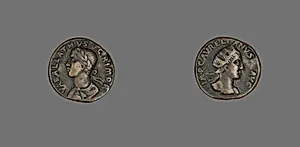
On the front (obverse) of this coin the king Vabalathus is portrayed, facing right and wearing a crown of laurels. On the back (reverse), the emperor Aurelian is similarly portrayed, facing right and wearing a crown.
Art Historical Context
This petite bronze coin, struck around 270-275 CE, offers a glimpse into the turbulent Crisis of the Third Century in Roman Empire. Measuring just 1.8 cm in diameter, it King Vabalathus—also known as Vaballus—ruler of the short-lived Palmyrene Empire Syria. The obverse likely features his regal portrait, a common Roman numismatic tradition blending imperial authority with local power, while the reverse may depict deities or symbols affirming his legitimacy. Vabalathus, son of the warrior-king Odenathus, co-ruled with his mother Zenobia during Rome's fragmentation. These coins, minted in Palmyra, boldly proclaimed his titles like "King of Kings" and even "Augustus," signaling independence from a weakened Rome amid barbarian invasions and civil wars. As propaganda tools, they circulated as everyday currency, bridging Hellenistic, Roman, and Eastern influences. In the Art Institute of Chicago's Arts of Greece, Rome, and Byzantium collection, this coin exemplifies ancient minting techniques—hammer-struck dies creating incised details on bronze flans. Its survival highlights numismatics' role in piecing together forgotten histories, reminding us how tiny artifacts encoded grand ambitions.
About the Artist
Ancient Roman
The artists attributed to "Ancient Roman" in museum collections represent the anonymous craftsmen who produced the vast output of sculpture, frescoes, mosaics, and reliefs defining Roman visual culture from the Republic (c. 509–27 BCE) to the late Empire (c. 395 CE). Individual identities remain elusive, as Roman makers were typically viewed as skilled tradesmen—often enslaved Greeks or provincial...