
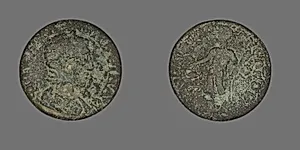
Coin Portraying the Empress Tranquillina
193-217
Medium
Bronze
Dimensions
Diam.: 2.2 cm (7/8 in.)
Classification
coin
Department
Arts of Greece, Rome, and Byzantium
Museum
Art Institute of Chicago
Accession Number
142901
Rights
Public Domain
Art Historical Context
This exquisite bronze coin, measuring a mere 2.2 cm in diameter captures the dignified profile of Empress Tranquillina ancient Rome, dating to the turbulent years of 193–217 AD.uck during a period of imperial transition and military strife in the Severan dynasty's aftermath, such coins were everyday currency that doubled as powerful tools of propaganda. By portraying the empress—likely as a symbol of stability and divine favor—Roman mints broadcast the regime's legitimacy across the vast empire, from bustling markets to distant frontiers. Artistically, the coin exemplifies Roman numismatic mastery: finely engraved dies produced sharp, realistic portraits with flowing hair, imperial drapery, and subtle inscriptions, techniques honed over centuries for mass production yet retaining individualized likenesses. Bronze, a common alloy for smaller denominations, ensured accessibility while highlighting the era's advanced metallurgy. As a classification in numismatics, it reveals how emperors and empresses like Tranquillina shaped public identity through portable art. Housed in the Art Institute of Chicago's Department of Arts of Greece, Rome, and Byzantium, this unassuming artifact whispers tales of power, piety, and the human face of empire—reminding us that history often circulated one coin at a time.
About the Artist
Ancient Roman
The artists attributed to "Ancient Roman" in museum collections represent the anonymous craftsmen who produced the vast output of sculpture, frescoes, mosaics, and reliefs defining Roman visual culture from the Republic (c. 509–27 BCE) to the late Empire (c. 395 CE). Individual identities remain elusive, as Roman makers were typically viewed as skilled tradesmen—often enslaved Greeks or provincial...