
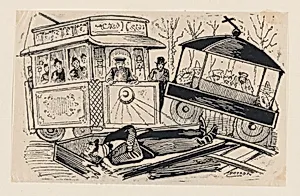
Collision between a trolley and a hearse
ca. 1880–1910
Medium
Zincograph
Dimensions
Sheet: 3 3/4 × 6 3/16 in. (9.5 × 15.7 cm)
Classification
Prints
Department
Drawings and Prints
Museum
Metropolitan Museum of Art, New York, NY
Credit
Gift of Jean Charlot, 1930
Accession Number
30.82.98
Rights
Public Domain
Tags
Art Historical Context
José Guadalupe Posada, a pioneering Mexican printmaker active in Mexico City during the late 19th and early 20th centuries, captures the chaos of urban life in *Collision between a trolley and a hearse* (ca. 1880–1910). This zincograph depicts a dramatic street accident between a modern streetcar—symbolizing rapid industrialization—and a traditional hearse, with corpses, men, and women scattered in the mayhem. Posada's satirical broadsheets often blended dark humor with social commentary, using death as a great equalizer to poke fun at everyday tragedies and societal shifts. Printed on a small zinc plate (3 3/4 × 6 3/16 in.), this affordable zincograph allowed for mass production via lithography, making Posada's works accessible to the working class through newspapers and chapbooks. His bold, black-line style influenced later Mexican artists like Diego Rivera and became iconic in Day of the Dead traditions, where skeletons dance through life's absurdities. Today, this print from the Metropolitan Museum of Art's Drawings and Prints collection highlights Posada's role in shaping Mexico's visual culture, reminding us how art can wryly confront mortality amid progress. A gift from Jean Charlot in 1930, it invites visitors to chuckle at the macabre collision of old and new.
About the Artist
José Guadalupe Posada · 1852–1913
José Guadalupe Posada (1852-1913) was a Mexican printmaker and engraver who revolutionized popular art and created some of the most iconic images in Mexican culture. Working primarily with publisher Antonio Vanegas Arroyo, he produced over 20,000 images during his career—inexpensive broadsheets sold for a penny on colored paper that made his art accessible to even the poorest workers. He transform...