
Colosse médial du Spéos d'Phré, à Abousembil
March 29, 1850
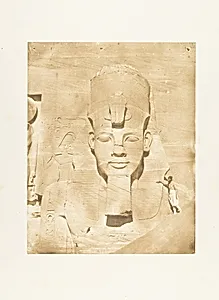
Medium
Salted paper print from paper negative
Dimensions
Image: 8 3/8 × 6 5/8 in. (21.2 × 16.8 cm) Mount: 18 11/16 × 12 5/16 in. (47.5 × 31.2 cm)
Classification
Photographs
Department
Photographs
Museum
Metropolitan Museum of Art, New York, NY
Credit
Gilman Collection, Gift of The Howard Gilman Foundation, 2005
Accession Number
2005.100.376.148
Rights
Public Domain
Tags
Art Historical Context
Step into the sun-baked sands of ancient Egypt with Du Camp's *Col médial du Spé d'Phré, à Abousembil*, a salted paper print captured on March 29, 1850. This intimate 8 3/8 × 6 5/8 in. photograph depicts the towering central colossus from the Speos of Ptah, a rock-cut temple at Abu Simbel, showcasing the monumental sculpture and architecture of pharaonic Egypt. Du Camp, a pioneering French photographer and traveler, made this image during his 1849–1850 expedition alongside writer Gustave Flaubert, one of the earliest photographic surveys of Egypt's antiquities. Printed from a paper negative using the calotype process—a breakthrough technique invented by William Henry Fox Talbot—this work highlights the medium's revolutionary ability to document remote, crumbling wonders with unprecedented detail and tonal richness. The soft, matte surface of salted paper evokes the hazy desert light, preserving the colossus's weathered grandeur for posterity amid 19th-century Europe's growing fascination with Egyptomania. Today, housed in The Metropolitan Museum of Art's Gilman Collection, this photograph bridges worlds: it immortalizes Ramses II-era splendor while marking photography's dawn as an archaeological tool, inviting us to marvel at how a fragile print outlasts stone.
About the Artist
Maxime Du Camp · 1822–present
Maxime Du Camp (1822–1894) was a pioneering French photographer and writer whose adventurous spirit and technical innovation bridged literature and visual art during the mid-19th century. Born in Paris on February 8, 1822, to a prosperous family—his father a successful surgeon—Du Camp received a solid bourgeois education at the Collège Bourbon (now Lycée Condorcet), where he cultivated interests i...