
Colosseum te Rome
1748 - 1778
Medium
etching
Dimensions
705; 444
Rights
Public Domain
About this artwork
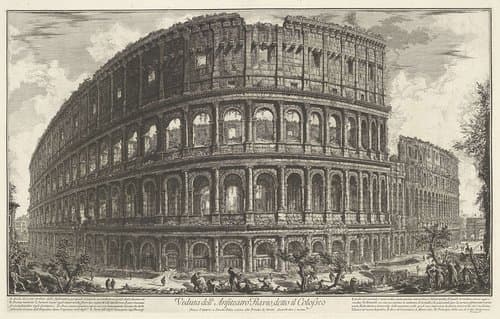
Gezicht op het Colosseum te Rome. Op de achtergrond rechts de Boog van Constantijn. Titel en lijst met verklarende letters in ondermarge.
Art Historical Context
Step into the majestic ruins of ancient Rome with Giovanni Battista Piranesi's *osseum te Rome* (1748–1778), a stunning etching that captures the awe-inspiring Colosseum from a dramatic vantage point. In the foreground, the massive amphitheater dominates, its weathered arches and tiers evoking the grandeur of the Flavian emperors' era, while the Arch of Constantine looms elegantly in the background to the right. Piranesi, a Venetian-born master of 18th-century vedute (topographical views), produced this as part of his renowned *Vedute di Roma* series, meticulously documenting Rome's ancient monuments during the height of the Grand Tour era, when European aristocrats flocked to Italy for cultural inspiration. Rendered in etching—a technique Piranesi perfected for its precision and depth—this large-scale print (444 × 705 mm) showcases his virtuosic line work, creating intricate textures of stone and shadow that convey both architectural accuracy and romantic sublime. The lower margin features the title and a keyed list of explanatory letters, guiding viewers through the scene like a personal tour, blending education with artistry. Piranesi's works fueled neoclassical revival and a fascination with antiquity's decay versus endurance, influencing architects and artists from Soane to Turner. This piece invites us to ponder Rome's eternal legacy, a timeless bridge between past and present.
About the Artist
Giovanni Battista Piranesi · 1720–1778
Giovanni Battista Piranesi (1720–1778) was an Italian printmaker, architect, and antiquarian whose visionary etchings of Rome and imaginary prisons revolutionized architectural representation and profoundly influenced both Neoclassicism and Romanticism. Piranesi stands as one of the most important printmakers of the eighteenth century, fundamentally shaping European perceptions of ancient Rome an...