
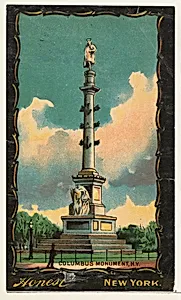
Columbus Monument, New York, from the Transparencies series (N137) issued by W. Duke, Sons & Co. to promote Honest Long Cut Tobacco
late 1880s
Medium
Commercial color lithograph
Dimensions
Sheet: 4 3/16 × 2 1/2 in. (10.6 × 6.4 cm)
Classification
Prints|Ephemera
Department
Drawings and Prints
Museum
Metropolitan Museum of Art, New York, NY
Credit
The Jefferson R. Burdick Collection, Gift of Jefferson R. Burdick
Accession Number
63.350.207.137.7
Rights
Public Domain
Tags
Art Historical Context
Step into the vibrant world of 19th-century advertising with this petite commercial color lithograph from. Duke, Sons &.'s Transparencies series (N137). in the late 1880s, this 4 3/16 × 2 1/2-inch print depicts New York City's Columbus Monument, a symbol of exploration and American pride honoring Christopher Columbus. As ephemera from the Metropolitan Museum of Art's Jefferson R. Burdick Collection it captures how everyday commerce turned historical icons into collectible treasures. Chromolithography, the medium's star technique, allowed for bold, multi-layered colors printed in mass quantities—perfect for tucking into tobacco pouches of Duke's Honest Long Cut Tobacco. This innovative process democratized art, making vivid imagery accessible to the public and fueling the trading card craze. Duke's Sons & Co., a tobacco powerhouse, cleverly blended patriotism with promotion, reflecting the era's growing fascination with Columbus amid anticipation for the 1892 monument dedication and World's Columbian Exposition. Today, this tiny transparency reminds us of advertising's artistic flair and cultural pulse, bridging monumental history with pocket-sized nostalgia. A delightful glimpse into Gilded Age ingenuity!
About the Artist
W. Duke, Sons & Co. · 1870–1920
**W. Duke, Sons & Co.: Pioneers of Chromolithographic Trade Card Art** W. Duke, Sons & Co., an American tobacco manufacturer, emerged from the entrepreneurial vision of Washington Duke (1820–1905) and his sons in Durham, North Carolina. After the Civil War, Washington abandoned farming in 1874 to join his eldest son, Brodie L. Duke, in the burgeoning tobacco trade, establishing a factory that for...