
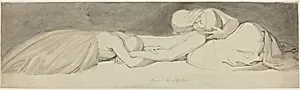
Comfort the Afflicted
c. 1790
Medium
pen and gray ink with gray and brown wash over graphite on laid paper
Dimensions
overall: 13.3 x 45.6 cm (5 1/4 x 17 15/16 in.)
Classification
Drawing
Department
CG-E
Museum
National Gallery of Art, Washington, D.C.
Credit
Paul Mellon Collection
Accession Number
1986.72.7
Rights
Public Domain
Art Historical Context
"Comfort the Afflicted is a delicate drawing by the esteemed British neoclassical artist John Flaxman, created around 1790. Executed in pen and gray ink with gray brown wash over graphite on laid paper, this work measures 13.3 x 45.6 cm and exemplifies Flaxman's mastery of linear elegance. Housed in the National Gallery Art's Paul Mellon Collection it captures the refined aesthetic of late 18th Britain, where neoclassicism drew inspiration from ancient Greek and Roman art during the Enlightenment era. Flaxman, a pioneering sculptor and illustrator, was renowned for his spare, outline-driven style that influenced book illustrations for Homer and Dante. Here, the combination of precise graphite underdrawing, fluid ink lines, and subtle washes creates depth and emotional resonance on modest laid paper—a period staple valued for its texture and absorbency. This technique allowed artists like Flaxman to prepare compositions for sculpture or engraving with remarkable clarity and grace. The evocative title suggests a scene of compassion, aligning with neoclassical ideals of moral virtue and human empathy. As a preparatory drawing, it highlights Flaxman's role in bridging classical antiquity with contemporary sentiment, offering visitors a window into the thoughtful process behind his enduring legacy.
About the Artist
John Flaxman · 1755–1826
John Flaxman (1755–1826) was born in York, England, the son of John Flaxman Sr., a moulder and seller of plaster casts who ran a studio in London's Covent Garden. Largely self-taught amid his father's stock of classical casts, with minimal formal schooling due to childhood illness, Flaxman displayed prodigious talent early on. At age 12, he won a Society of Arts prize for a medallion; by 15, anoth...