
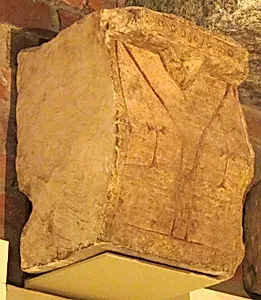
Console with Incised Lines and Crosses
Unknown Artist
6th–7th century
Medium
Limestone, red pigment; incised
Dimensions
H. 12 3/4 in. (32.4 cm) W. 10 1/4 in. (26 cm) D. 10 1/4 in. (26 cm)
Classification
Sculpture
Department
Islamic Art
Museum
Metropolitan Museum of Art, New York, NY
Credit
Rogers Fund, 1910
Accession Number
10.175.49
Rights
Public Domain
Art Historical Context
This modest limestone console, carved in the 6th–7th century, offers a glimpse into the early artistic traditions of the Islamic world. Standing just over 12 inches tall, wide, and deep, it served as an architectural support, perhaps in a building or niche. The surface bears incised lines and crosses, enhanced with traces of red pigment—a technique that highlights the motifs through subtle color contrast. Incising, a precise method of scratching designs into stone, was both practical for durable limestone and economical, allowing artisans to create intricate patterns without deep carving. Housed in the Metropolitan Museum of Art's Department of Islamic Art (acquired via the Rogers Fund in 1910), this sculpture reflects the transitional cultural landscape of late antiquity in the Near East. During this era, as Islam emerged, artistic motifs like crosses—possibly echoing pre-Islamic Christian influences or serving as abstract decoration—blended with emerging geometric styles. Its simplicity underscores the resourcefulness of early makers, prioritizing function and subtle symbolism over elaboration. A quiet testament to everyday artistry, it invites visitors to ponder the shared visual language bridging ancient faiths and the dawn of Islamic culture.