
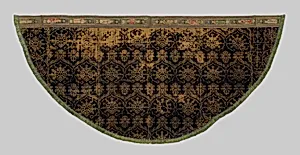
Cope with an Orphrey
Unknown Artist
15th century
Medium
Silk, wool, linen,
Dimensions
From center back neck to hem, with fringe: 55 1/4 x 168 3/4 in. (circumference of hem) (140.3 x 428.6 cm)
Classification
Textiles-Ecclesiastical
Culture
Italian and French
Department
Robert Lehman Collection
Museum
Metropolitan Museum of Art, New York, NY
Credit
Robert Lehman Collection, 1975
Accession Number
1975.1.1841
Rights
Public Domain
Art Historical Context
Step into the opulent world of 15-century ecclesiastical splendor with this magnificent *Cope with an Orphrey from the Robert Lehman Collection The Metropolitan Museum of Art.ed in sumptuous silk, wool, and linen, this vestment hails from Italian and French workshops, reflecting the era's fusion of artistic traditions during the late Middle Ages and early Renaissance. A cope is a semicircular mantle worn by clergy during solemn processions and Masses, its vast scale—from the center back neck to hem measuring 55¼ inches, with a hem circumference of 168¾ inches—emphasizing its dramatic presence in grand cathedrals. The orphrey, a richly embroidered central band, would have showcased intricate motifs symbolizing faith, such as saints, biblical scenes, or floral designs, though specifics here remain veiled by time. Woven and stitched with precious materials, these textiles demanded masterful techniques, blending weaving, embroidery, and possibly metallic threads for a shimmering effect under candlelight. Their creation involved skilled artisans, often in collaborative European centers like those in Italy and France, where silk trade routes fueled innovation. As a rare survivor of opulent church finery, this cope highlights the cultural devotion to visual piety in the 15th century, when such garments bridged the divine and the earthly. Donated in 1975, it invites us to ponder the hands that fashioned it and the rituals it graced. (218 words)