
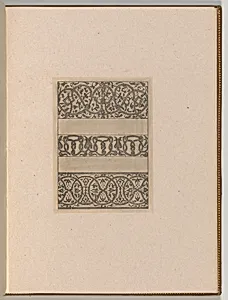
Copies after the 'Livre contenant passement de moresques' (plate 18)
19th century (?)
Medium
Etching (?)
Dimensions
Sheet: 4 13/16 × 3 9/16 in. (12.2 × 9 cm) Plate: 4 1/2 × 3 5/16 in. (11.5 × 8.4 cm) Overall: 10 1/16 × 7 7/8 in. (25.5 × 20 cm)
Classification
Albums|Prints|Ornament & Architecture
Department
Drawings and Prints
Museum
Metropolitan Museum of Art, New York, NY
Credit
Purchase, Susan Schulman Printseller Gift, 2014
Accession Number
2014.94.18
Rights
Public Domain
Tags
Art Historical Context
This delicate etching, titled *Copies after the 'Livre contenant passement de moresques (plate 18)*, pays homage to the Renaissance master Jacques Androuet Du Cer (ca. 1515–1585), a pioneering French architect and engraver Created in the 19th century as faithful reproductions, these small prints (measuring just 4½ × 3⅜ inches) capture plate 18 from Du Cerceau's influential book on *moresques*—intricate, interlacing patterns inspired by Islamic art from the Moorish tradition. His original works, published in the 1540s–60s, blended Northern European precision with exotic ornamental motifs, fueling the Renaissance fascination with decorative symmetry and complexity. Du Cerceu's *Livre contenant passement de moresques* showcased *passement* designs—elaborate braid-like trims and arabesques—that adorned architecture, textiles, and metalwork across Europe. These copies preserve that legacy, highlighting how 16th-century etchers used fine lines and cross-hatching to evoke infinite, knot-like rhythms, evoking a sense of mathematical elegance and cultural exchange. Housed in the Metropolitan Museum of Art's Drawings and Prints department, this piece exemplifies the enduring appeal of ornament in design history, bridging Renaissance innovation with 19th-century revivalism. (178 words)
About the Artist
Jacques Androuet Du Cerceau · 1510–1585
Jacques I Androuet du Cerceau (c. 1510–1584), born in Paris to a wine merchant, emerged as a pivotal figure in introducing Renaissance architecture to France through his innovative designs and engravings. Trained as an architect, decorator, and engraver, he established a printshop in Orléans around 1549, where he began producing influential suites of engravings, starting with triumphal arches. His...