
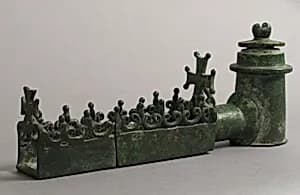
Copper-Alloy Faucet and Conduit
Unknown Artist
6th–7th century
Medium
Copper alloy
Dimensions
Overall: 5 1/4 x 12 3/8 x 3/16 in. (13.3 x 31.4 x 0.4 cm) faucet: 5 1/4 x 2 11/16 in. (13.3 x 6.8 cm) conduit in 2 parts: 4 1/8 x 10 3/8 x 2 5/16 in. (10.5 x 26.3 x 5.8 cm)
Classification
Metalwork-Copper alloy
Culture
Byzantine
Department
Medieval Art
Museum
Metropolitan Museum of Art, New York, NY
Credit
Fletcher Fund, 1947
Accession Number
47.100.41a, b
Rights
Public Domain
Art Historical Context
This exquisite copper-alloy faucet and conduit, crafted in the Byzantine Empire during the 6th7th century, offers a rare glimpse into the sophisticated engineering and artistry of early medieval Constantinople. Dating to a time when the Eastern Roman Empire flourished amid grand architectural projects like Hagia Sophia, this functional metalwork piece likely served in a public bathhouse, fountain, or ecclesiastical setting, channeling water with remarkable precision. Its survival highlights the Byzantines' mastery of hydraulics, inherited from Roman traditions and refined for enduring use. The object's design—comprising a spout-like faucet and a two-part conduit—demonstrates advanced copper-alloy casting techniques, where molten metal was poured into molds and possibly finished with chasing or incising for durability and subtle decoration. Byzantine metalwork often blended utility with aesthetic restraint, favoring clean lines over ornate excess, reflecting the era's Christian ethos of practicality and divine order. Housed in The Metropolitan Museum of Art's Medieval Art department (acquired via the Fletcher Fund in 1947), this artifact underscores the cultural importance of everyday innovations in Byzantine society. It reminds visitors that behind the empire's glittering mosaics lay a world of ingenious plumbing that sustained urban life for centuries.