
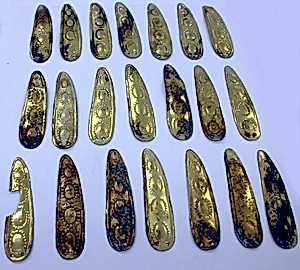
Copper Peapod Ornament
Unknown Artist
12th–15th century
Medium
Copper, gilt
Dimensions
Length 3-1/2 in. (8.8 cm)
Classification
Metal-Ornaments
Culture
Chimú (?)
Department
Arts of Africa, Oceania, and the Americas
Museum
Metropolitan Museum of Art, New York, NY
Credit
Bequest of Jane Costello Goldberg, from the Collection of Arnold I. Goldberg, 1986
Accession Number
1987.394.274
Rights
Public Domain
Art Historical Context
This delicate Copper Peapod Ornament, dating from the 12th to 15th century, exemplifies the masterful metalworking traditions of the Chimú culture—or a closely related group—in ancient Peru. Crafted from copper and enhanced with gilding, small ornament (just 3-1/2 inches long) mimics the organic form of a peapod split open to reveal its seeds. Such naturalistic motifs were common in Chimú art, blending everyday observation with symbolic resonance, possibly evoking fertility, abundance, or the natural world central to Andean life. The Chimú, who flourished along Peru's northern coast before Inca conquest around 1470, were renowned for their advanced metallurgy. Artisans hammered and chased copper into intricate shapes, then applied a thin layer of gold via gilding techniques like depletion gilding or mercury amalgamation, creating a luxurious sheen on a more accessible base metal. This piece, likely worn as jewelry or a decorative adornment, highlights their skill in miniaturization and surface decoration. Today, housed in the Metropolitan Museum of Art's Department of the Arts of Africa, Oceania, and the Americas, this bequest from Jane Costello Goldberg reflects the enduring allure of Chimú craftsmanship. It invites us to ponder how such tiny treasures bridged the practical and the poetic in pre-Columbian societies.