
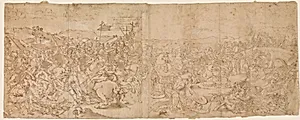
Copy after the Fresco with the Battle of Constantine in the Vatican Palace
1499–1546
Medium
Pen and brown ink, brush and brown wash
Dimensions
15-7/8 x 40-9/16 in. (40.4 x 103 cm)
Classification
Drawings
Department
Drawings and Prints
Museum
Metropolitan Museum of Art, New York, NY
Credit
Gift of Cornelius Vanderbilt, 1880
Accession Number
80.3.670
Rights
Public Domain
Tags
Art Historical Context
This dynamic drawing by Giulio Romano captures a pivotal moment from the Battle of Constantine, a grand fresco cycle in the Vatican Palace’s di Costantino. Created between 1499 and 1546, Romano—a leading pupil of Raphael—produced this study after the monumental frescoes that celebrated Emperor Constantine’s victory at the Milvian Bridge in 312 CE. The scene highlights clashing warriors on horseback beneath a prominent cross, evoking the emperor’s legendary vision that led to his conversion to Christianity and the transformation of the Roman Empire. Executed in pen and brown ink with brush-applied brown wash, the work demonstrates Romano’s masterful draftsmanship and his role in disseminating Raphael’s designs. Such detailed copies served both as records of large-scale compositions and as tools for training younger artists. Measuring over three feet wide, the elongated format echoes the fresco’s architectural setting while allowing viewers to appreciate the rhythmic energy of the battle. Housed in the Metropolitan Museum of Art since 1880 as a gift of Cornelius Vanderbilt, this sheet offers an intimate glimpse into the collaborative world of Renaissance Rome. It preserves the dramatic movement and symbolic power of one of the Vatican’s most influential decorative programs, reminding us how drawings bridged the gap between grand public art and private study.
About the Artist
Giulio Romano · 1499–1546
Giulio Romano (c. 1499–1546) was the most gifted pupil of Raphael and one of the founding figures of Mannerism, the style that succeeded the High Renaissance in Italy. Born Giulio Pippi in Rome, he entered Raphael's workshop as a boy and proved so talented that by the time of Raphael's death in 1520 he was effectively running the studio and overseeing the completion of major unfinished commissions...