
Corner Cupboard
1935/1942
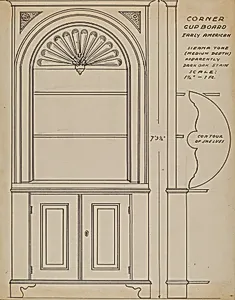
Medium
pen and ink and graphite on paper
Dimensions
overall: 27.8 x 22 cm (10 15/16 x 8 11/16 in.) Original IAD Object: none given
Classification
Index of American Design
Department
CG-W
Museum
National Gallery of Art, Washington, D.C.
Credit
Index of American Design
Accession Number
1943.8.4893
Rights
Public Domain
Art Historical Context
In the heart of the Great Depression, Ferdinand Cartier captured the elegance of American craftsmanship with his *Corner Cupboard* (1935/1942), a precise pen-and-ink drawing with graphite on paper, measuring 27.8 x 22 cm. As part of the Federal Art Project's Index of American Design—a WPA initiative from 1935 to 1942—this work meticulously documents a classic piece of colonial-era furniture. Corner cupboards, with their triangular form fitting snugly into room corners, were staples in 18th-century American homes, often showcasing regional woodworking traditions through carved moldings, paneled doors, and delicate hardware. Cartier's rendering highlights the object's architectural details and subtle proportions, blending technical accuracy with artistic sensitivity. The Index aimed to celebrate everyday American design, from folk art to antiques, creating a visual archive for future generations. Housed in the National Gallery of Art's collection, this drawing not only preserves a vanishing artifact but also underscores the era's push to value national heritage amid economic hardship. Today, it invites us to appreciate how such humble furnishings embodied colonial ingenuity, bridging utility and beauty in early American life.
About the Artist
Ferdinand Cartier · 1892–1987
Ferdinand Cartier is an artist whose historical record remains limited. No confirmed birth or death dates have been established, and his national origin and training background are not documented in surviving sources, making it difficult to place him within any specific artistic tradition or school. Cartier's presence in museum collections, with close to fifty works attributed to him, points to a...