
Corpus Christi
Medium
paper
Dimensions
60; 76
Rights
Public Domain
About this artwork
Gift of Jonkvrouw A.C. Teding van Berkhout, Amsterdam and S.F., Baroness van Höevell-Teding van Berkhout, Bergen (Noord-Holland)
Art Historical Context
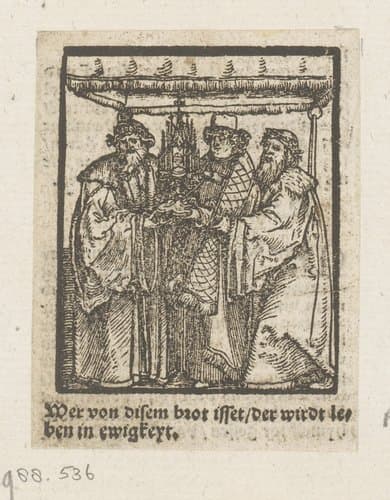
**Corpus Christi (1536)** This delicate anonymous artwork, titled *Corpus Christi*, dates to 1536 and measures just 76 mm high by 60 mm wide, making it a pocket-sized treasure likely intended for personal devotion. Created on paper—a medium increasingly popular in the 16th century for prints—this piece emerges from the Renaissance era, a time when Northern European artists produced countless small-scale religious images using techniques like woodcuts or engravings. Its modest dimensions suggest it was designed for intimate use, perhaps carried by the faithful during processions or private prayer. The title *Corpus Christi*, referencing the Catholic feast celebrating the Body of Christ and the Eucharist, underscores its spiritual significance amid the religious upheavals of the early Reformation. Anonymous works like this were common, allowing widespread dissemination of sacred imagery without individual attribution, reflecting the era's emphasis on piety over fame. Generously gifted to the collection by Jonkvrouw A.C. Teding van Berkhout of Amsterdam and S.F., Baroness van Höevell-Teding van Berkhout of Bergen (Noord-Holland), it connects us to Dutch aristocratic patronage, preserving a snapshot of 16th-century faith and artistry. Though details are sparse, its survival highlights the enduring cultural role of such ephemera in everyday devotion.