
Cosmetic Jar
5th-7th century
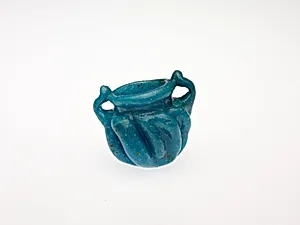
Medium
Glass, core-formed technique
Dimensions
H.: 5.1 cm (2 in.)
Classification
personal grooming / hygiene / cosmetic container
Department
Arts of Greece, Rome, and Byzantium
Museum
Art Institute of Chicago
Accession Number
67471
Rights
Public Domain
About this artwork
Glass containers were used to store cosmetics, including scented oils and kohl, a mineral compound used to dramatic effect to darken eyelids and eyelashes. Containers for cosmetics were fashioned out of a variety of materials in addition to glass, including metal, ivory, bone, and wood. In his writings, the third-century church father Saint Clement of Alexandria (d. 215) mentions white lead, charcoal, and even the “droppings of crocodiles” as common ingredients for cosmetics, although he must be...
Art Historical Context
Nestled in the Art Institute of Chicago's collection of Arts of Greece,, and Byzantium, delicate Cosmetic Jar exemplifies the refined craftsmanship of the Byzantine Empire during the 5th to 7th centuries. Standing just 5.1 cm tall, this small glass vessel was designed for personal grooming—likely holding precious ointments, perfumes, or cosmetics that adorned the elite in Constantinople and beyond. The Byzantine world, bridging late antiquity and the medieval era, was a hub of splendor, where such intimate luxury items reflected the empire's wealth, trade networks spanning the Mediterranean, and a love for beauty in everyday life. Crafted using the ancient core-formed technique, the jar was meticulously shaped by winding trails of colored glass around a removable clay or sand core, then smoothing and polishing the surface. This labor-intensive method, inherited from Roman and Near Eastern traditions, allowed artisans to create vibrant, translucent forms without molds. Its survival highlights the durability of Byzantine glassmaking, a craft that symbolized technical mastery and artistic continuity amid political upheavals. As a window into Byzantine domestic culture, this jar reveals how personal hygiene and adornment were elevated to art forms, underscoring the era's blend of practicality and opulence. Visitors can appreciate how such unassuming objects carried the empire's enduring legacy of elegance.
About the Artist
Byzantine
"Byzantine" is the collective attribution given to anonymous artists working within the Eastern Roman (Byzantine) Empire, whose creations spanned from the 4th to the 15th centuries, primarily in Constantinople and its cultural sphere. These masters produced a vast body of art that defined an era, with museums like the Walters Art Museum and the Art Institute of Chicago cataloging numerous works un...