
Costume Armor in the Classical Style
ca. 1788–90
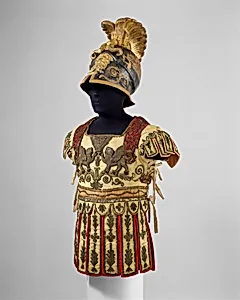
Medium
Helmet: linen, papier-mâché, bole, gold leaf, graphite; tunic: silk, cotton, metal coils and spangles, metallic yarn
Dimensions
armor: H. 26 3/4 in. (68 cm); W. 22 7/16 in. (57 cm); D. 11 in. (28 cm); helmet: H. 15 3/4 in. (40 cm); W. 7 11/16 in. (19.5 cm); D. 13 3/4 in. (35 cm)
Classification
Costumes
Culture
French, Paris
Department
Arms and Armor
Museum
Metropolitan Museum of Art, New York, NY
Credit
Funds from various donors, 1988
Accession Number
1988.65.1–.2
Rights
Public Domain
Art Historical Context
Step into the opulent world of late 18th-century French theater with *Costume Armor in the Style* by Hallé, crafted around 1788–90 in Paris. This striking ensemble, housed in the Metropolitan Museum of's Arms and Armor Department yet classified as a costume, the grandeur of ancient Greek and Roman. During the waning years of the Ancien Régime, neoclassicism swept through French arts, inspired by archaeological discoveries at Pompeii and Herculaneum. Such costumes were donned by actors in lavish spectacles or festive pageants, blending historical fantasy with revolutionary fervor on the horizon. Hallé masterfully replicated the heft of battle armor using lightweight, theatrical materials: a helmet of linen and papier-mâché, gilded with bole and gold leaf for a radiant, antique sheen, paired with a tunic of silk, cotton, and shimmering metal coils, spangles, and yarn. Measuring about 27 inches tall, this wearable illusion prioritized dazzle over defense—perfect for the stage's footlights. Its Parisian origins highlight the city's renown as a hub for innovative costume design, where artisans like Hallé transformed everyday fabrics into symbols of heroic antiquity. This piece offers a window into how fashion and fantasy fueled cultural imagination just before the French Revolution, reminding us that armor could be as much about performance as protection.