
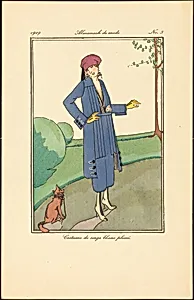
Costume de serge blanc plissé.
Medium
offset lithograph with watercolor applied through a stencil (pochoir print)
Dimensions
plate: 17.1 x 12 cm (6 3/4 x 4 3/4 in.) sheet: 22.2 x 14.2 cm (8 3/4 x 5 9/16 in.)
Classification
Department
CG-W
Museum
National Gallery of Art, Washington, D.C.
Credit
George M. Richter Archive
Accession Number
1994.43.3
Rights
Public Domain
Art Historical Context
Step into the elegant world of 1920s Parisian fashion with *Costume de serge blancissé* (Pleated White Serge Costume), delicate 1919 offset lith enhanced by pochoir—a stencil-applied watercolor technique. Created by an anonymous French artist the early 20th century, this print a chic, pleated dress in crisp white serge fabric, evoking the post-World War I optimism and liberation in women's style. At just 17.1 x 12 cm on the plate, its intimate scale invites close admiration, much like a page from a high-society fashion journal. The pochoir method, beloved by avant-garde publications like *Gazette du Bon Ton* and *Vogue*, allowed for vivid, handcrafted color effects over the lithographic base, mimicking original watercolor illustrations while enabling affordable reproduction. This hybrid technique bridged fine art and commercial design, highlighting the artistry behind haute couture during the dawn of Art Deco. Housed in the National Gallery of Art's George M. Richter Archive (Department CG-W), this print reflects the cultural fervor of 1919 France, where fashion became a canvas for modernity and joy after wartime austerity. A timeless snapshot of evolving silhouettes, it reminds us how clothing told stories of reinvention.
About the Artist
French 20th Century · 1900–1999
**French 20th Century** is the standard museum catalog designation used for unattributed or anonymous French artists active during the 20th century, encompassing a wide range of works in institutional collections. With 26 artworks attributed under this heading in the present collection, the label serves as a practical way to group paintings, drawings, and other pieces whose creators remain unident...