
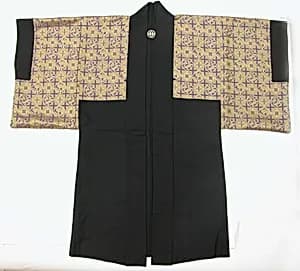
Costume of a Japanese Gentleman
Unknown Artist
19th century
Medium
(a) Silk,metalic thread / Plain weave (b) Silk / Plain weave (c) Silk / Plain weave (d) Cotton; Silk / Plain weave (e) Silk / Plain weave (f) Silk / Braided (g) Straw, leather / Woven (h) Straw, leather / Woven (i) Rush; leather; silk; wood / Woven (j) Rush; leather; silk; wood / Woven (k) Cotton / Knit (l) Cotton / Knit
Dimensions
Overall (a): 51 x 53 1/2 in. (129.5 x 135.9 cm) Overall (b): 61 x 50 in. (154.9 x 127 cm) Overall (c): 42 x 29 1/2 in. (106.7 x 74.9 cm) Overall (d): 40 x 52 in. (101.6 x 132.1 cm) Overall (e): 159 x 4 1/8 in. (403.9 x 10.5 cm) Overall (f): 23 in. (58.4 cm) Overall (g (left)): 10 x 3 1/2 in. (25.4 x 8.9 cm) Overall (h (right)): 10 x 3 1/2 in. (25.4 x 8.9 cm) Overall (i): 9 1/2 x 4 in. (24.1 x 10.2 cm) Overall (j): 9 1/2 x 4 in. (24.1 x 10.2 cm) Overall (k): 9 3/4 x 3 in. (24.8 x 7.6 cm) Overall (l): 9 3/4 x 3 in. (24.8 x 7.6 cm) Overall: 23 in. (58.4 cm)
Classification
Textiles-Costumes
Culture
Japan
Department
Asian Art
Museum
Metropolitan Museum of Art, New York, NY
Credit
Gift of Mrs. Howard Mansfield, 1950
Accession Number
50.110.1a–m
Rights
Public Domain
Art Historical Context
This exquisite 19th-century *Costume of a Japanese* offers a glimpse into the refined elegance of Edo-period (or early Meiji) attire, when silk garments symbolized social status and cultural sophistication. Comprising multiple components—including flowing silk robes (a-e), a braided silk cord (f), woven straw-and-leather sandals (g-j), and knit cotton tabi socks (k-l)—this ensemble would have been worn by an upper-class man for formal occasions, evoking the harmony of form and function in Japanese dress. Crafted primarily from plain-weave silk, some pieces incorporate shimmering metallic threads for subtle luxury, while footwear blends durable rush, straw, leather, and wood for practicality on tatami mats or streets. These techniques highlight Japan's mastery of textiles, where natural fibers and intricate weaving reflected seasonal and hierarchical nuances—silk for prestige, cotton for everyday resilience. A generous gift to the Metropolitan Museum of Art from Mrs. Howard Mansfield in 1950, this costume preserves the artistry of anonymous Japanese craftspeople, inviting us to appreciate how clothing embodied identity, ritual, and beauty in pre-modern Japan.