
Cottage Beside a Canal With a View of Ouderkerk
c. 1641
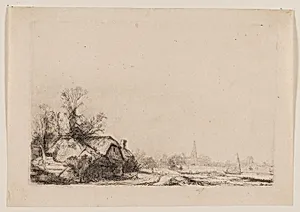
Medium
Etching on cream laid paper
Dimensions
Plate: 13.7 × 20.7 cm (5 7/16 × 8 3/16 in.); Sheet: 16.7 × 24.2 cm (6 5/8 × 9 9/16 in.)
Classification
etching
Department
Prints and Drawings
Museum
Art Institute of Chicago
Accession Number
29179
Rights
Public Domain
Art Historical Context
In the serene etching *Cottage Beside a Canal With a View of Ouderkerk* (c. 1641), Rembrandt van Rijn captures the tranquil Dutch countryside near Amsterdam. Created during the Dutch Golden Age, this print depicts a modest cottage hugging a winding canal, with the distant village of Ouderkerk aan de Amstel visible on the horizon. Rembrandt, a master of the Baroque style, occasionally turned from his famed portraits and biblical scenes to landscape etchings like this one, revealing his deep appreciation for the flat, watery expanses of his homeland. Etching on cream laid paper, the work measures a compact plate size of 13.7 × 20.7 cm, allowing for intimate detail in Rembrandt's revolutionary technique. He drew intricate lines into a copper plate with a needle, then submerged it in acid to etch varying depths, producing rich textures—from the thatched roof's roughness to the shimmering water and misty sky. This innovative drypoint and burr use creates luminous effects, making the monochrome print feel alive with light and atmosphere. Housed in the Art Institute of Chicago's Prints and Drawings Department, this piece highlights Rembrandt's printmaking genius, which influenced generations. It invites visitors to ponder the everyday beauty that inspired one of history's greatest artists amid the prosperity of 17th-century Holland.
About the Artist
Rembrandt van Rijn · 1606–1669
Rembrandt Harmenszoon van Rijn (1606–1669) stands as one of the greatest visual artists in the history of Western art and the most important Dutch painter of the 17th century. Born in Leiden to a prosperous miller's family, Rembrandt transformed painting through his revolutionary use of light and shadow, his psychological depth in portraiture, and his elevation of etching to a fine art. His approx...