
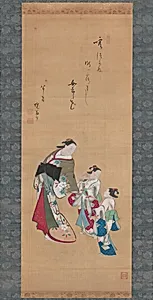
Courtesan and Two Attendants
About 1705
Medium
Hanging scroll; ink and colors on silk
Dimensions
Painting: 83.4 × 33.2 cm (32 13/16 × 13 1/16 in.); With mounting: 171.5 × 46.6 cm (67 1/2 × 18 5/16 in.)
Classification
hanging scroll
Department
Arts of Asia
Museum
Art Institute of Chicago
Accession Number
24463
Rights
Public Domain
Art Historical Context
Torii Kiyonobu I's *Courtesan and Attendants* (ca. 1705) is a captivating hanging scroll from Japan's vibrant Edo period, exemplifying the ukiyo-e tradition of "pictures of the floating world." Created in ink and colors on silk this vertical painting measures about 83 cm tall, designed to be unrolled and displayed in intimate domestic settings. The luxurious silk surface allows for luminous hues and delicate gradations, highlighting the artist's mastery of yamato-e influences blended with emerging ukiyo-e realism. The scene portrays a glamorous courtesan from the Yoshiwara pleasure district, flanked by her attendants—a quintessential subject in early 18th-century Japanese art. Kiyonobu, a founder of the Torii school, specialized in bijin-ga (images of beautiful women) and yakusha-e (actor portraits), capturing the elegance and transience of urban life amid the Genroku era's cultural flourishing. This work reflects the era's fascination with fashion, poise, and fleeting pleasures, offering a window into the refined world of Edo's entertainment quarters. Housed in the Art Institute of Chicago's Arts of Asia department, this scroll underscores the Torii school's pivotal role in bridging painting and woodblock printmaking, influencing later masters like Utamaro. Its intimate scale invites viewers to appreciate the subtle interplay of gesture, pattern, and color, evoking the artistry of a bygone pleasure culture.
About the Artist
Torii Kiyonobu I · 1664–1729
Torii Kiyonobu I (1664–1729), born Shōbei in Osaka, was the second son of Torii Kiyomoto, a prominent kabuki actor specializing in onnagata roles and a painter of theater signboards. He studied painting under his father as well as Yoshida Hanbei and Hishikawa Moronobu, the pioneering ukiyo-e master whose figure styles profoundly shaped his early work. In 1687, at age twenty-four, Kiyonobu accompan...