
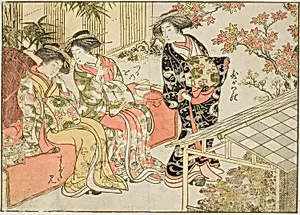
Courtesans of Tsuruya, from the book "Mirror of Beautiful Women of the Pleasure Quarters (Seiro bijin awase sugata kagami)," vol. 2
1776
Medium
Color woodblock print; double-page illustration cut from a book
Dimensions
22.6 × 30.2 cm (8 7/8 × 11 7/8 in.)
Classification
woodblock print
Department
Arts of Asia
Museum
Art Institute of Chicago
Accession Number
32249
Rights
Public Domain
Art Historical Context
Step into the vibrant world of Edo-period Japan *Courtesans of Tsur*, a captivating double-page color woodblock print by Kitao Shigemasa created in 1776 Extracted from volume 2 of the illustrated book *Mirror of Beautiful Women of the Pleasure Quarters (iro bijin awaseata kagami)*, this 22.6 × 30.2 cm artwork exemplifies ukiyo-e, the "pictures of the floating world genre that celebrated fleeting pleasures like theater, fashion, and romance. Shigemasa, a master of bijin-ga (images of beautiful women), skillfully captures the elegance of high-ranking courtesans from Tsuruya, a house in Tokyo's Yoshiwara district—the famed licensed pleasure quarter. These women, adorned in luxurious kimonos and intricate hairstyles, embody idealized beauty and cultural allure, reflecting the era's fascination with urban sophistication amid Japan's isolationist policies. The medium's brilliance lies in Nishiki-e (brocade pictures), where multiple woodblocks layered vibrant colors and fine details, making art accessible via affordable prints. Housed in the Art Institute of Chicago's Arts of Asia department, this piece offers a window into 18th-century Japan's social tapestry, blending artistry with the ephemeral charm of its pleasure districts.
About the Artist
Kitao Shigemasa · 1739–1820
Kitao Shigemasa (1739–1820), born in the bustling Nihonbashi district of Edo (modern Tokyo), emerged as a pivotal figure in ukiyo-e woodblock printing during Japan's Edo period. The eldest son of the bookseller Suharaya Mohei—from a lineage of publishers—Shigemasa, originally named Kitabatake Tarōkichi, was immersed in the world of printing from youth. Largely self-taught, he later studied under t...