
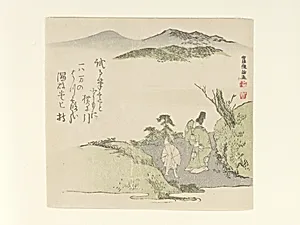
Courtier and Young Attendant Gazing at a Landscape
1796
Medium
Woodblock print (surimono); ink and color on paper, textured ground
Dimensions
4 7/8 x 5 1/4 in. (12.4 x 13.3 cm)
Classification
Prints
Culture & Period
Japan · Edo period (1615–1868)
Department
Asian Art
Museum
Metropolitan Museum of Art, New York, NY
Credit
Purchase, Marjorie H. Holden Gift, 2012
Accession Number
2012.248.22
Rights
Public Domain
Tags
Art Historical Context
In the intimate woodblock print *Courtier and Young Att Gazing at a Landscape (1796), Kubo Shunman captures a serene moment from Japan's Edo period (1615–1868). This surimono—a luxurious, privately commissioned print often created for New Year's greetings or poetic gatherings—depicts an elegant courtier and his young attendant pausing to admire a distant vista. The small scale (just 4 7/8 x 5 1/4 inches) invites viewers into a private reverie, blending human figures with evocative landscapes in the ukiyo-e tradition of "pictures of the floating world." Shunman's mastery shines in the refined application of ink and vibrant colors on textured paper, a technique that adds tactile depth and subtle embossing for a premium feel. Produced during a golden age of Japanese printmaking, when urban culture flourished in Edo (modern Tokyo), this work reflects the era's fascination with nature's beauty and the contemplative joys of elite society. Surimono like this were prized for their wit, calligraphy, and seasonal motifs, often shared among literati. Held in the Metropolitan Museum of Art's Asian Art Department, this piece exemplifies how everyday woodblock printing evolved into high art, bridging artistry and social ritual in 18th-century Japan.
About the Artist
Kubo Shunman · 1757–1820
Japanese, 1757–1820