
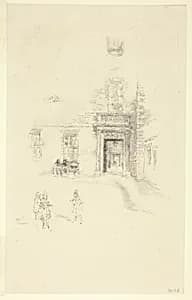
Courtyard, Chelsea Hospital
Medium
Lithograph, in black ink, with stumping, on cream wove paper
Dimensions
Image: 21.5 × 16.2 cm (8 1/2 × 6 7/16 in.); Sheet: 31.6 × 19.6 cm (12 1/2 × 7 3/4 in.)
Classification
lithograph
Department
Prints and Drawings
Museum
Art Institute of Chicago
Accession Number
139410
Rights
Public Domain
Art Historical Context
James McNeill Whistler, renowned American-born artist celebrated for his "art for art's sake philosophy and subtle tonal harmonies, captured the serene everyday life of London's Chelsea neighborhood in *Courtyard, Chelsea Hospital* (1888). Living nearby in the late 1880s, Whistler turned his gaze to the historic Royal Hospital Chelsea—a venerable retirement home for military veterans founded by Charles II. This intimate lithograph depicts its quiet courtyard, evoking a sense of timeless calm amid Victorian urban bustle. Printed in black ink with stumping—a technique using a soft tool to blend and soften tones on cream wove paper—the work exemplifies Whistler's mastery of lithography. This planographic method, where greasy crayon resists water on a stone or plate, allowed him to achieve painterly effects akin to his famous nocturnes, with velvety shadows and atmospheric depth. At just 21.5 × 16.2 cm, the image invites close viewing, highlighting his shift toward printmaking as a democratic medium after financial setbacks. Housed in the Art Institute of Chicago's Prints and Drawings Department, this piece from Whistler's Chelsea series underscores his influence on modern art, bridging Impressionism and Symbolism. It reminds us how ordinary spaces, rendered with exquisite subtlety, can transcend into poetry.
About the Artist
James McNeill Whistler · 1834–1903
James Abbott McNeill Whistler (1834-1903) was an American-born painter and printmaker who became a leading figure in the Aesthetic Movement and pioneer of Tonalism and Japonisme. He revolutionized art by championing "art for art's sake" and treating paintings as visual equivalents of musical compositions, titling works as "arrangements," "harmonies," and "nocturnes" to emphasize formal qualities o...