
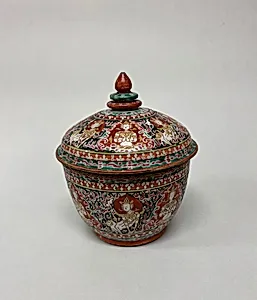
Covered bowl with Buddhism images
Unknown Artist
19th century
Medium
Porcelain painted in overglaze polychrome enamels (Bencharong ware)
Dimensions
H. 8 in. (20.3 cm); Diam. 6 1/8 in. (15.6 cm)
Classification
Ceramics
Culture & Period
China · Qing dynasty (1644–1911)
Department
Asian Art
Museum
Metropolitan Museum of Art, New York, NY
Credit
Avery Fund, 1909
Accession Number
09.70.15a, b
Rights
Public Domain
Tags
Art Historical Context
This elegant covered bowl, adorned with vivid Buddhist images, hails from 19th-century China during the Qing dynasty (1644–1911). Crafted by an unknown artist, it exemplifies Bencharong ware—a luxurious porcelain type painted in overglaze polychrome enamels. Standing 8 inches (20.3 cm) high with a diameter of 6⅛ inches (15.6 cm), its compact form made it ideal for ceremonial use, such as holding offerings or spices. Bencharong, meaning "five colors" in Thai, was produced in Jingdezhen kilns but customized for Thailand's royal courts, blending Chinese ceramic mastery with Southeast Asian motifs. The overglaze enameling technique allowed for brilliant hues—typically reds, blues, greens, yellows, and blacks—applied after firing and refired at lower temperatures for a glossy finish. Here, human figures likely depict Buddhist deities or scenes, symbolizing spiritual devotion amid opulent daily life. Acquired through the Avery Fund in 1909, this piece in the Metropolitan Museum of Art's Asian Art collection highlights Sino-Thai cultural exchange. Its intricate designs not only showcase technical virtuosity but also evoke the Qing era's global trade networks, bridging East Asian artistry with Buddhist reverence.