
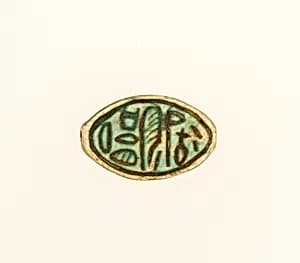
Cowroid Naming Queen Ahmose Nefertari
Unknown Artist
ca. 1550–1525 B.C.
Medium
Glazed steatite
Dimensions
l. 1.9 cm (3/4 in); w. 1.2 cm (1/2 in); th.0.5 cm (3/16 in)
Classification
Cowroid, Queen Ahmose Nefertari
Period
New Kingdom
Department
Egyptian Art
Museum
Metropolitan Museum of Art, New York, NY
Credit
Gift of Helen Miller Gould, 1910
Accession Number
10.130.172
Rights
Public Domain
Art Historical Context
Behold the delicate *Cowroid Naming Queen Ahmose Nefertari*, a tiny glazed steatite amulet from Egypt's New Kingdom, crafted around 1550–1525 B.C. during the early 18th Dynasty. Measuring just 1.9 cm long, this cowrie-shell-shaped seal—known as a "cowroid"—bears an inscription honoring Ahmose Nefertari, a pivotal queen who was wife to Ahmose I, the pharaoh who expelled the Hyksos invaders and reunified Egypt, ushering in an era of imperial splendor. Ahmose Nefertari's prominence is evident in this intimate object, likely used as a personal seal or protective talisman. Her name's inclusion underscores her divine status; she was later venerated as a goddess of healing and the necropolis at Thebes. Cowroids, mimicking the sacred cowrie shell symbolizing fertility and rebirth, blended practical function with spiritual power in ancient Egyptian life. Carved from soft steatite and vividly glazed—probably in blue or green for an eternal sheen—this miniature masterpiece showcases the era's masterful lapidary skills. Donated to the Metropolitan Museum of Art in 1910, it offers a window into royal devotion and the New Kingdom's artistic finesse.