
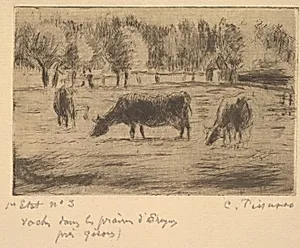
Cows in the Fields of Éragny, near Gisors
1888
Medium
Drypoint on laid paper; first state of two
Dimensions
sheet: 8 7/8 x 10 3/8 in. (22.6 x 26.4 cm) plate: 3 1/8 x 4 3/4 in. (8 x 12.1 cm)
Classification
Prints
Department
Drawings and Prints
Museum
Metropolitan Museum of Art, New York, NY
Credit
The Elisha Whittelsey Collection, The Elisha Whittelsey Fund, 1962
Accession Number
62.650.162
Rights
Public Domain
Tags
Art Historical Context
Camille Pissarro’s *Cows in the Fields of Éragny, near Gisors captures a quiet moment in the rural landscape of northern France, where the artist settled in 1884. Created in1888, the print reflects Pissarro’s enduring fascination with the everyday rhythms of life and the countryside surrounding his home. As a leading figure of the Impressionist movement, Pissarro often turned to such scenes to celebrate the harmony between humans, animals, and nature. This delicate drypoint on laid paper showcases the artist’s mastery of printmaking techniques. In drypoint, the copper plate is scratched directly with a needle, raising a soft burr that holds ink and produces velvety lines. As the first state of two, this impression reveals Pissarro’s initial vision before further refinements, highlighting the spontaneity and texture characteristic of his graphic work. The small scale of the plate—only about three by five inches—invites intimate viewing, drawing attention to the gentle presence of cows among trees. Through this modest yet evocative print, Pissarro conveys both the simplicity of rural existence and the subtle beauty of the French landscape during the late nineteenth century.
About the Artist
Camille Pissarro · 1831–1903
Camille Pissarro (1830-1903) stands as the patriarch of Impressionism, the only artist to exhibit in all eight Impressionist exhibitions and a mentor whose influence shaped the trajectory of modern art. Born Jacob Abraham Camille Pissarro on the Caribbean island of St. Thomas to a Jewish-Portuguese merchant family, he abandoned the family business to pursue painting, eventually settling in Paris i...