
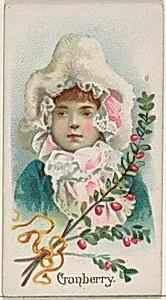
Cranberry, from the Fruits series (N12) for Allen & Ginter Cigarettes Brands
Medium
Commercial color lithograph
Dimensions
Sheet: 2 3/4 x 1 1/2 in. (7 x 3.8 cm)
Classification
Prints|Ephemera
Department
Drawings and Prints
Museum
Metropolitan Museum of Art, New York, NY
Credit
The Jefferson R. Burdick Collection, Gift of Jefferson R. Burdick
Accession Number
63.350.201.12.13
Rights
Public Domain
Tags
Art Historical Context
Step into the vibrant world of 19th-century American advertising with *Cranberry*, a charming chromolithograph from Allen & Ginter's Fruits series (N12), produced in 1891 by George S. Harris & Sons. This petite card, measuring just 2¾ x 1½ inches, was inserted into cigarette packs as a promotional collectible, sparking a collecting craze among consumers. Allen & Ginter, pioneering tobacco marketers, used these ephemera to entice buyers, blending commerce with colorful artistry. The commercial color lithograph technique shines here, layering vivid inks to capture the juicy reds of cranberries alongside delicate depictions of girls and plants—evoking innocence and nature's bounty. As part of the Metropolitan Museum of Art's Jefferson R. Burdick Collection, it exemplifies the era's ephemera: everyday prints now treasured for their historical snapshot. These cards highlight lithography's role in democratizing art, turning advertising into accessible beauty. Fun fact: Series like N12 fueled a hobby that endures today, preserving glimpses of Gilded Age marketing ingenuity. (198 words)
About the Artist
Allen & Ginter|George S. Harris & Sons
Allen & Ginter, the pioneering American tobacco firm based in Richmond, Virginia, emerged around 1880 from the partnership of John F. Allen and Lewis Ginter, evolving from Allen's earlier John F. Allen & Company. Allen retired in 1882, succeeded by John Pope, yet the brand endured under Ginter's leadership, employing over 1,100 workers—mostly women—for hand-rolled cigarettes by 1886. Ginter, a Dut...