
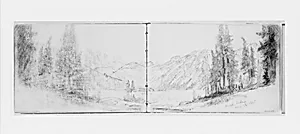
Crater Lake Aug 23, 1885 (from Sketchbook X)
Medium
Graphite on off-white wove paper
Dimensions
5 x 7 1/2 in. (12.7 x 19.1 cm)
Classification
Drawing
Culture
American
Department
The American Wing
Museum
Metropolitan Museum of Art, New York, NY
Credit
Purchase, Gifts in memory of Stephen D. Rubin, 1992
Accession Number
1992.2.2dd
Rights
Public Domain
Tags
Art Historical Context
William Trost Richards, a American artist of the Hudson River School captured the majestic beauty of Crater Lake in intimate graphite sketch dated August 23, 1885. Tucked within Sketchbook X, the drawing depicts the Oregon landmark's serene waters nestled amid towering mountains—a testament to Richards' lifelong passion for precise, naturalistic landscapes. At just 5 x 7½ inches, it reflects his meticulous on-site sketching during travels across the American West, blending Romantic reverence for nature with scientific observation. Richards, influenced by Pre-Raphaelite detail and Luminist clarity, favored graphite on off-white wove paper for its smooth surface, ideal for rendering subtle tones and textures. This medium allowed quick yet evocative studies, foundational to his larger oil and watercolor works celebrating America's wilderness. Created in the Gilded Age, when national parks were emerging, the sketch underscores the era's growing appreciation for pristine landscapes amid rapid industrialization. Now in The Metropolitan Museum of Art's American Wing, purchased in 1992, this piece invites visitors to ponder Crater Lake's timeless allure through Richards' keen eye—a window into 19th-century exploration and artistic devotion to the sublime.
About the Artist
William Trost Richards · 1833–1905
William Trost Richards (1833–1905) was a prominent American landscape and marine painter born in Philadelphia, where he attended Central High School before beginning his artistic training. Between 1850 and 1855, he studied part-time under the German-born Hudson River School artist Paul Weber while working as a designer and illustrator of ornamental metalwork. He exhibited his first works at the Pe...