
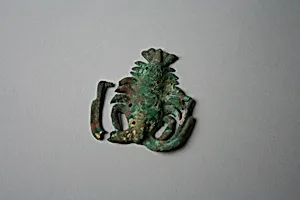
Crayfish
Unknown Artist
6th–7th century
Medium
Gilded copper
Dimensions
Length 2 in. (5 cm)
Classification
Metal-Ornaments
Culture
Moche
Department
Arts of Africa, Oceania, and the Americas
Museum
Metropolitan Museum of Art, New York, NY
Credit
Gift of Jane Costello Goldberg, from the Collection of Arnold I. Goldberg, 1981
Accession Number
1981.459.15
Rights
Public Domain
Tags
Art Historical Context
This exquisite gilded copper crayfish, crafted by an unknown Moche artist around the 6th–7th century, measures just 2 inches (5 cm) long, yet captures the intricate details of its subject with remarkable precision. Hailing from the Moche culture of ancient Peru's northern coast, this small ornament exemplifies society's mastery of metalworking. Moche (ca. 100–700 CE), renowned for their sophisticated ceramics and metallurgy, often depicted marine life like crayfish in their art, possibly symbolizing the vital coastal ecosystems that sustained them. Gilding copper—a technique involving a thin gold overlay on a copper base—created a luxurious sheen, making such ornaments ideal for elite jewelry, headdresses, or ritual adornments. This shimmering effect not only highlighted the crayfish's segmented body, claws, and antennae but also elevated everyday motifs to divine status, reflecting Moche beliefs in the spiritual power of nature. Discovered among artifacts from their pyramid-building society, it offers a glimpse into a world where artistry intertwined with cosmology. Today, this treasure resides in The Metropolitan Museum of Art's Department of the Arts of Africa, Oceania, and the Americas, a gift from the Collection of Arnold I. Goldberg in 1981. It invites visitors to marvel at how a tiny creature from over 1,300 years ago bridges us to the ingenuity of pre-Columbian Peru.