
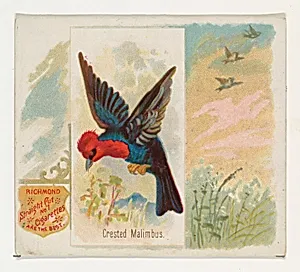
Crested Malimbus, from the Song Birds of the World series (N42) for Allen & Ginter Cigarettes
Medium
Commercial color lithograph
Dimensions
Sheet: 2 7/8 x 3 1/4 in. (7.3 x 8.3 cm)
Classification
Prints|Ephemera
Department
Drawings and Prints
Museum
Metropolitan Museum of Art, New York, NY
Credit
The Jefferson R. Burdick Collection, Gift of Jefferson R. Burdick
Accession Number
63.350.202.42.14
Rights
Public Domain
Tags
Art Historical Context
Step into the vibrant world of 19th-century advertising with *Crested Malimbus from the Song Birds of World series (N42, issued by the pioneering tobacco company Allen & Ginter in 1890. These diminutive color lithographs—measuring just 2 7/8 x 3 1/4 inches—were tucked into cigarette packs as collectible trade cards, sparking a craze among enthusiasts. Produced in collaboration with printers George S. Harris & Sons this series showcased exotic birds like the striking crested malimbus, a West African songbird with its vivid plumage, blending education with promotion in an era when such ephemera became everyday treasures. Chromolithography, the medium here, revolutionized mass printing by layering up to 30 colors for lifelike vibrancy on inexpensive paper, making fine art accessible to the masses. Allen & Ginter's cards, part of over 100 themed sets, predated modern trading cards and fueled collecting hobbies while subtly marketing their brands. Housed in the Metropolitan Museum of Art's Drawings and Prints department from The Jefferson R. Burdick Collection—a landmark gift of over 30,000 items—this piece highlights how commerce intertwined with natural history illustration, capturing global biodiversity for Victorian audiences. Today, it reminds us of birds' timeless allure, turning a simple ad into cultural artifact. (198 words)
About the Artist
Allen & Ginter|George S. Harris & Sons
Allen & Ginter, the pioneering American tobacco firm based in Richmond, Virginia, emerged around 1880 from the partnership of John F. Allen and Lewis Ginter, evolving from Allen's earlier John F. Allen & Company. Allen retired in 1882, succeeded by John Pope, yet the brand endured under Ginter's leadership, employing over 1,100 workers—mostly women—for hand-rolled cigarettes by 1886. Ginter, a Dut...